
1947: Brexit India (2023) – Superb; a rare 5
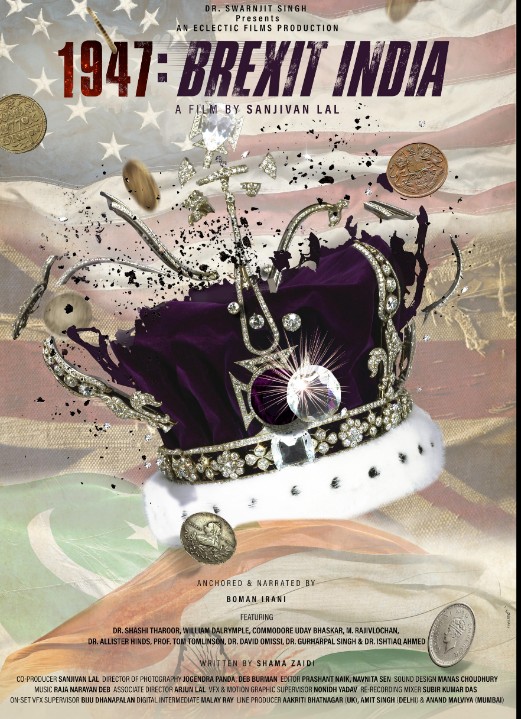
Genre: Documentary – The British and India
Platform: Amazon Prime Rent
Time: 2 hours
Director: Sanjivan Lal
Cast: William Dalrymple. Shashi Tharoor. Ishtiaq Ahmed. M. Rajivlochan. C. Uday Bhaskar. Allister Hinds. Tom Tomlinson
Narrator and Anchor: Boman Irani.
Plot: The 300 years of British presence in India from 1609 to 1947; from East India Company to Lord Mountbatten.
In his novel The Secret Pilgrim (1993), spy novelist John le Carre writes about how British behaved perfidiously, and that too repeatedly against trusting allies. In this case, the narrator of the story, Ned, talks about how Poles placed their trust on the British who proceeded to gayly abandon the Poles, once in 1939 against the Germans, and within six years in 1945, against the Soviet Union. The hero Ned concludes thus:
“Our repeated betrayals of their country have always seemed to me so disgraceful that if I were Polish, I would spit on every passing British shadow, whether I had suffered under the Nazis or the Russians, the British in their time having abandoned the poor Poles to both”.
I had similar feelings while watching this documentary – of spitting at every passing British shadow.
Anger aside , the history though appalling, is deeply interesting. What started as a private enterprise by a trading company, soon became in a hundred years, “The Jewel in the Crown” of the British Empire, thanks to the East India Company and then the British Crown merrily looting India in ever more innovative ways. The history of loot and deceit is told in a matter-of-fact way by British historians like Dalrymple, Hinds, Tomlinson etc all of whom are very clear that the British took much more from India than gave to it. Shashi Tharoor in his inimitable way also adds to the overall history with an Indian perspective – how many famines were deliberately created by the British ; the 1800s alone accounted for more deaths than the 1.5 million estimated deaths of the Bengal famine. Tharoor is also clear that there has been a lot of myth making of British benevolence and points this out from time to time. Other Indian historians present more evidence of how the British proceeded to destroy India , in the name of commerce, buying Indian clothes cheaply and selling British produce in much higher prices. An amazing added information is how Indian ship building was destroyed steadily over the years as Indian wooden ships lasted much longer compared to the British wooden ships, due to the much superior Indian craftsmanship and which was steadily destroyed by the British.
An interesting aside is that the East India Company was strictly business oriented and didn’t give too much thought to converting Indians into Christianity. That followed much later as the Missionaries went about their job of converting “heathens” into Christians. The early British were more practical – they took Indian wives, had children out of them, wore local dresses and ate Indian food. There is collateral evidence for these practices in the books Curry(2005) and The Hungry Empire (2017), both by British writer Lizzie Collingham , about the British hunger for spices , that ultimately led to Empire and the modern British obsession with “curry” and how the British increasingly adopted local cuisine and some cultural practices, such as multiple servants and wives.
Graphs, charts, contemporary paintings, historical photos, newsreels are interspersed with the dry commentary by anchor Boman Irani. Interestingly , clips from various feature films are inserted to prove a point.
Eg – The British stationed troops in multiple kingdoms – paid for by the Rajas of these kingdoms. This is proven with a clip from the film Lagaan (2001) where Captain Russel announces that taxes have to raised for “your protection” , gesturing at the King. These practices more or less bankrupted India. All these may be well known but still this is a comprehensive lesson in the overall “Empire experience’. A clip from Shatranj ke Khiladi (1977) is shown to prove how Awadh was annexed by the British while another clip from Ghare Bhaire (1984) discusses the Partition of Bengal.
The freedom movement also gets its share. The documentary correctly points out the political hara-kiri that the Congress committed by resigning unilaterally in protest against Lord Linlithgow’s declaration of war. The wrong timing of the 1942 Quit India movement, combined with the wholesale arrest of the Congress, paved the way for Muslim League, which had actually been in the doldrums earlier, and this is also pointed out in a dry manner.
This documentary has less to do with the freedom movement and more to do with the overall 300+ year British rule in India and how their rule ultimately proved divisive, since an economically and morally bankrupt “Great” Britain abandoned India and the Parthian shot of a divided India. I have absolutely no problem in recommending this superb documentary narrated and anchored by Boman Irani.
This is two hours well spent; and perhaps some time for self-reflection.
Total – 5 out of 5
Leave a Reply