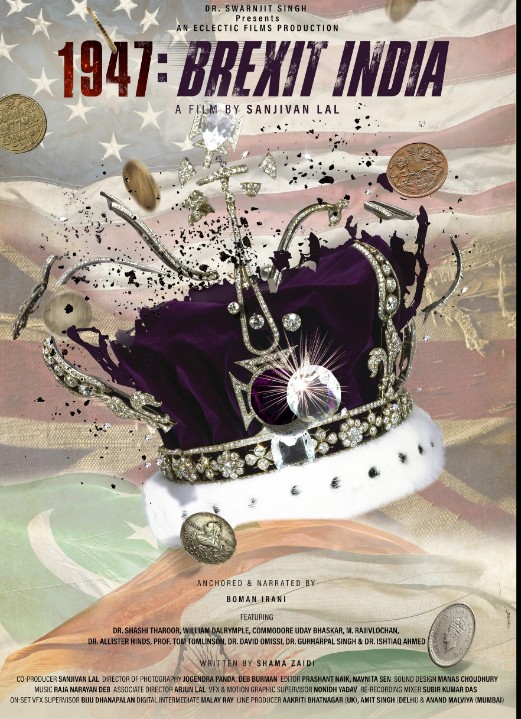
1947: Brexit India (2023) – Superb; a rare 5
3–5 minutes

Genre: Documentary – The British and India

Platform: Amazon Prime Rent

Time: 2 hours

Director: Sanjivan Lal

Cast:   William Dalrymple. Shashi Tharoor. Ishtiaq Ahmed. M. Rajivlochan. C. Uday Bhaskar. Allister Hinds. Tom Tomlinson

Narrator and Anchor: Boman Irani.

Plot:  The 300 years of British presence in India from 1609 to 1947;  from East India Company to Lord Mountbatten.

In his novel The Secret Pilgrim (1993), spy novelist John le Carre writes about how British behaved perfidiously, and that too repeatedly against trusting allies. In this case, the narrator of the story, Ned, talks about how Poles placed their trust on the British who proceeded to gayly abandon the Poles, once in 1939 against the Germans, and within six years in 1945, against the Soviet Union. The hero Ned concludes thus:  

“Our repeated betrayals of their country have always seemed to me so disgraceful that if I were Polish, I would spit on every passing British shadow, whether I had suffered under the Nazis or the Russians, the British in their time having abandoned the poor Poles to both”.

I had similar feelings while watching this documentary – of spitting at every passing British shadow.

Anger aside , the history though appalling, is deeply interesting. What started as a private enterprise by a trading company, soon became in a hundred years, “The Jewel in the Crown” of the British Empire, thanks to the East India Company and then the British Crown merrily looting India in ever more innovative ways. The history of loot and deceit is told in a matter-of-fact way by British historians like Dalrymple, Hinds, Tomlinson etc all of whom are very clear that the British took much more from India than gave to it. Shashi Tharoor in his inimitable way also adds to the overall history with an Indian perspective – how many famines were deliberately created by the British ; the 1800s alone accounted for more deaths than the 1.5 million estimated deaths of the Bengal famine. Tharoor is also clear that there has been a lot of myth making of British benevolence and points this out from time to time. Other Indian historians present more evidence of how the British proceeded to destroy India , in the name of commerce, buying Indian clothes cheaply and selling British produce in much higher prices. An amazing added information is how Indian ship building was destroyed steadily over the years as Indian wooden ships lasted much longer compared to the British wooden ships, due to the much superior Indian craftsmanship and which was steadily destroyed by the British.

An interesting aside is that the East India Company was strictly business oriented and didn’t give too much thought to converting Indians into Christianity. That followed much later as the Missionaries went about their job of converting “heathens” into Christians. The early British were more practical – they took Indian wives, had children out of them, wore local dresses and ate Indian food. There is collateral evidence for these practices in the books Curry(2005) and The Hungry Empire (2017), both by British writer Lizzie Collingham , about the British hunger for spices , that ultimately led to Empire and the modern British obsession with “curry” and how the British increasingly adopted local cuisine and some cultural practices, such as multiple servants and wives.

Graphs, charts, contemporary paintings, historical photos, newsreels are interspersed with the dry commentary by anchor Boman Irani. Interestingly , clips from various feature films are inserted to prove a point.

Eg – The British stationed troops in multiple kingdoms – paid for by the Rajas of these kingdoms. This is proven with a clip from the film Lagaan (2001) where Captain Russel announces that taxes have to raised for “your protection” , gesturing at the King. These practices more or less bankrupted India. All these may be well known but still this is a comprehensive lesson in the overall “Empire experience’. A clip from Shatranj ke Khiladi (1977) is shown to prove how Awadh was annexed by the British while another clip from Ghare Bhaire (1984) discusses the Partition of Bengal.

The freedom movement also gets its share. The documentary correctly points out the political hara-kiri that the Congress committed by resigning unilaterally in protest against Lord Linlithgow’s declaration of war. The wrong timing of the 1942 Quit India movement, combined with the wholesale arrest of the Congress, paved the way for Muslim League, which had actually been in the doldrums earlier, and this is also pointed out in a dry manner.

This documentary has less to do with the freedom movement and more to do with the overall 300+ year British rule in India and how their rule ultimately proved divisive, since an economically and morally bankrupt “Great” Britain abandoned India and the Parthian shot of a divided India. I have absolutely no problem in recommending this superb documentary narrated and anchored by Boman Irani.

This is two hours well spent; and perhaps some time for self-reflection.

Total – 5 out of 5

2 responses to “1947: Brexit India (2023) – Superb; a rare 5”

  1. Robin Bhat avatar
    Robin Bhat

    Hi Rammesh,

    Another superb review, by someone whom I regard as a history-teacher… or at least history-whisperer :)
    —

    Books which should be required reading on the subject:

    ‘Inglorious Empire’ and ‘An Era of Darkness’. Both by Shashi Tharoor.

    And

    ‘Churchill’s Secret War: The British Empire and the Ravaging of India during World War II’, by Madhusree Mukerji.
    —
    The other day, I accidentally fell across ‘The Journal of Historical Geography’, and an article on the subject. Will send it to you offline… but… one point:

    “Employing a novel systems approach to analyse historical causality, this study shows how volcanism, climate and society – especially the ruling British East India Company – contributed to the Madras (1832—1833) and Agra (1836—1838) famines”.

    Yes, volcanos.

    Thanks,

    Robin

    1. Rammesh avatar
      Rammesh

      Hi Robin

      History whisperer. I rather like that.

      The documentary is excellent and calls a spade a spade.

      Both the Tharoor and Mukherji book are among my TBR pile :(

      KVR

      KVR

Leave a Reply

Your email address will not be published. Required fields are marked *

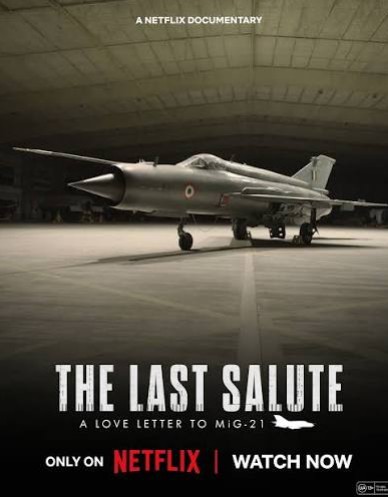
The Last Salute (2026); a love letter to the MiG-21 – Heartfelt tribute

7–10 minutes

Clickable links in red

Subject:  The MiG-21’s retirement from the Indian Air Force in September 26, 2025

Its not every day that such a momentous and truly historic event happens and is celebrated publicly. There have been many planes before in the Indian Air Force/ Armed Forces history but none of them have been the subject of a documentary and that too by Netflix.  Hunter, Sukhoi Su7, Canberra, Sea Hawk, Sea Harrier and many more were retired in ceremonies where only the service personnel were present . Since the giant Tupolev Tu-142 was replaced by the Boeing P-8I , it was a strictly Indian Navy event with very few outsiders allowed and there are very few clips available .

But none of them are subject of a full length movie/ documentary.

Background history of the MiG-21: The Mikoyan Gurevich (the name of the two lead designers of the MiG design bureau) MiG-21 was a product of the late 1950s thinking of catching high flying (30,000 feet + ) American bombers and shooting them down. Since it was all a matter of time to intercept, the plane had to be fast , fast , fast. Thus came the delta wing design which , as with any design, has both advantages and disadvantages; the main disadvantage were the high speeds of takeoff and landing. But it did the job and quickly at that. The 1950s thinking was that a plane could fire missiles at stand off ranges and shoot down an intruding bomber. It was NOT designed to be a dogfighter that would go against another fighter. The Americans too had similar delta wing designs for the US Air Force, the Convair F-102 Delta Dagger and the Convair F-106 Delta Dart, both of which served – unsurprisingly – as pure interceptors, intercepting Soviet Tu95 bombers which ‘tickled’ American radars into operation, thus enabling them to record the radar signature for future (conflicts , if that happened). The French delta design was the famous Mirage III which found fame against MiGs in the Middle East Wars (see below).

Operation Diamond and bad reputation: The Americans badly wanted a MiG-21 in their kitty so that they could study its weaknesses and take suitable counter measures. They sent the word out and lo and behold, they had a MiG-21 with them. Israel’s Mossad’s Operation Diamond persuaded an Iraqi Christian pilot to defect to Israel, in return for asylum for him and his family . The full details are available at this wiki link https://en.wikipedia.org/wiki/Operation_Diamond. Steal the Sky is a 1988 film on this operation , though it shows a MiG-17 instead of a MiG-21 .

The Israelis flew the plane on their Independence Day , painting it in a primal red color and giving it a cheeky and infamous serial number ,007. (Wiki link shows the same picture). The Israelis and Americans dismissed the plane as a supersonic sports car and thanks to “bad handling” by the Arab pilots during the 1967 Six Day war, shot down many in air to air combat, with many further destroyed in the waves of attacks on airfields.  (Those interested can check out videos on this topic by a You Tuber Showtime 112). It is however the post WW2 combat aircraft that was the most manufactured at 10,000+ units. Here’s a link from April 2026 that mentions some of these facts https://migflug.com/afterburner/the-mig-21-10000-built-60-countries-still-flying/

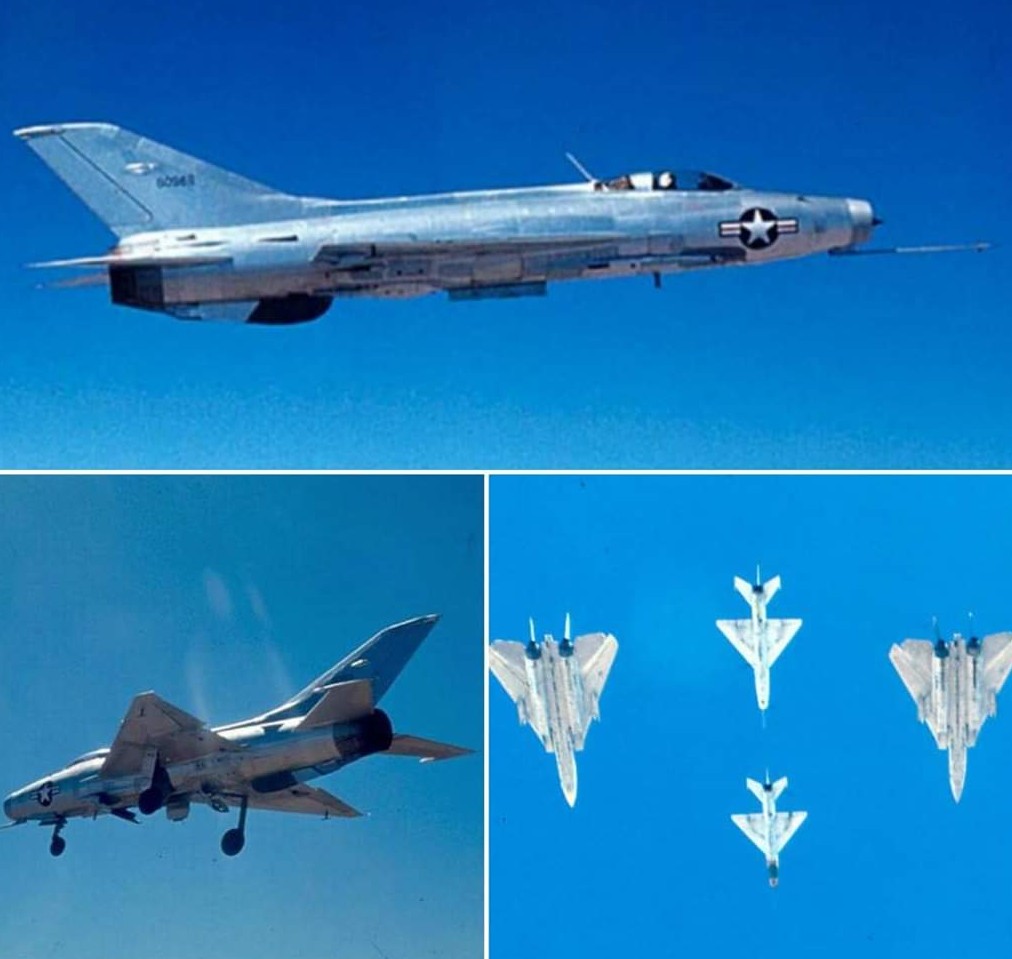
The US secret program Constant Peg: Despite their dismissal of the MiG-21 as a supersonic sports car, such was the US obsession with MiGs that they actually used real MiGs in a secret program called Constant Peg ; This was where MiG-15s, MiG-17s, MiG-19s, MiG-21s were actually bought secretly from various countries and used to train American fighter pilots. If that sounds weird and unbelievable, the above link on Constant Peg and the below photos of MiG-21s in US Air Force markings, in formation with US Navy F-14s should disprove this (and these pics are at least 15 – 20 years old._

India’s use: India actually wanted the Lockheed F-104 Starfighter . often dubbed missile with a man , due to its sleek design, but thanks to Cold War politics, ended up buying the MiG-21. There were just 10 MiG-21s in the 1965 war , 3 of which were destroyed on the ground by Pakistani attacks. Mostly they ended up doing CAP (Combat Air Patrol) – wasteful but essential duty of orbiting over a select area , ready to shoot down any intruding enemy planes. By the 1971 war, license manufacturing of the MiG-21 was well under way and it proved its worth very well , though sadly this was not trumpeted from the rooftops unlike Pakistan, which continued to share fabricated stories of Indian planes being shot down in droves.

MiG-21 in Indian Air Force combat use: The moment of truth arrived in the 1971 war in the Jamnagar sector when two MiG-21s met its contemporary adversary, the Lockheed F-104 Starfighter. The MiG-21s fired their missiles which missed , since most first generation air to air missiles were notoriously prone to failure. Though the Russians had supplied some gun packs and refused to take any more ownership saying that the MiG-21 was not a gunfighter, the Indian Air Force proved that the spirit of “positive jugaad” prevailed, resulting in shooting down the intruding F-104 off the Jamnagar coast, with guns. Here’s an excellent link from the superb Website on Indian Armed Forces Bharat-Rakshak . Sadly this incident is NOT COVERED in detail in this documentary which gives more focus on the Eastern Sector, where the MiG-21s were mostly used for ground attacks. It was a MiG-21 bombing attack that finally persuaded the Governor of East Pakistan to resign and within a day, the Pakistani Army surrendered.

By the time of the 1999 Kargil war, the IAF was operating the last variant of the MiG-21, the MiG-21 bis. While many aircraft types were involved in Operation Safed Sagar, the MiG-21 once again proved that it was a true multi role aircraft as it did photo recce, ground attack and CAP.

In the Balakot operations, a “2nd generation” MiG-21 supposedly shot down a “4th generation” F-16 and this is shown in the documentary as “Falcon Slayer”. Like all Indo-Pak war claims, this one is also highly debatable, as each side gives contradictory information about what happened. Since the truth about the 1965 and 1971 Indo Pak wars are available only now, after 50 to 60 years, we suppose we will have have to wait another 50 years for the truth to emerge about the claim of a F-16 shoot down by a MiG-21 :)

As an aside. it is worth mentioning that during the Vietnam war, the USAF F-4 Phantom pilots often complained that they didn’t get an opportunity to dogfight the MiG-21 , despite the F-4’s much “superior” technology and the MiG-21’s “inferior technology”. One pilot supposedly said “the Vietnamese MiG-21s could come screaming out of the sun, make a firing pass, disengage and vanish”.  Only fools would argue that this was “not right”; tactically it was the perfect thing to do since the Vietnamese had very limited number of MiGs. (During WW2, many German aces who had more than 200 kills used the same tactic of one firing pass and then scoot away, most notably ace of aces Erich Hartmann, with 352 air to air kills). The Vietnamese MiGs however fell prey to a ruse codenamed Operation Bolo, where the MiG-21s were lured into the air combat by F-4 Phantoms mimicking signals, flight paths, code names of the F-105 bombers and were shot down.

Bad reputation : This is tackled in some length in the documentary. After the end of the Cold war and the breakup of the Soviet Union, with many factories in the newly independent republics, a desperately broke Russia demanded hard cash for the spares at four or even five times the going price. Accordingly , alternative sources from the former Eastern Bloc countries and the new republics, were thought to be a lucrative source for spares. Some reports suggest that these spares were often defective and of low quality, resulting in the MiG-21’s reputation in the Indian press and public consciousness, as flying coffins/ widow maker, and so on. Just one such link (among many) is included here https://timesofindia.indiatimes.com/india/india-buying-faulty-mig-parts-russia/articleshow/20395007.cms This aspect, namely the MiG-21 is NOT a flying coffin, is covered in depth in the documentary, with many veteran officers pooh poohing the irresponsible press reports. As with most such things the truth lies somewhere between these two extremes. Rang de Basanti , the hit 2006 film , also made it, the core idea of the story since the somewhat unfocused, “vagabond” characters band together, to ‘avenge’ the death of their MiG-21 pilot friend, who loses his life due to “corruption in the system of buying low quality spares”.

Except for Operation Diamond, the 1971 combat operations, Vietnamese use, many of the above mentioned facts are covered well in-depth in the documentary. The picture that emerges is of a plane, a powerful beast, that once tamed , can be and proved to be a benign plane . One of its champions Air Commodore (Retd.) S.S.Tyagi who logged a record 4003 hours on the MiG-21, is almost in tears when he says he would love to fly the plane again. Here’s a lovely tribute to both the man and the plane in Anchit Gupta’s superb page on the Indian Air Force

Verdict :  Military nerds, like yours truly, simply love this film as its one of the rare Indian documentaries WITHOUT any jingoism and shows the man-machine interactions in detail than any jingoistic trumpeting However even the layman can watch it as most of the talking is done by the people who flew and maintained it ,both air and ground crew, which shows a picture of their enduring love for a much maligned beast of warplane.

Total – 5 out of 5

2 comments on The Last Salute (2026); a love letter to the MiG-21 – Heartfelt tribute