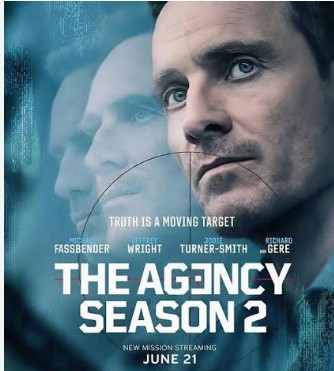
The Agency – Season 2 – 2026. Uneven yet ultimately engrossing

Genre: Spy Thriller

Platform: Jio Hotstar

Time: 10 episodes x average 50 minutes

Cast:    Michael Fassbender (Martian). Jeffrey Wright (Henry Ogletree). Katherine Waterston (Naomi). Harriet Sansom Harris (Dr. Blake). Saura Lightfoot-Leon (Daniela aka Danny). Jodie Turner-Smith (Samia Zahir). Richard Gere (Bosko, Head of London Station). India Fowler (Poppy).Hugh Bonneville (James Richardson).


Plot:  Martian is under suspicion for multiple reasons – his continued interest in retrieving Samia Zahir from Sudan, his supposed liaison contacts with MI6 officer Richardson, his plans to turn a vicious mercenary using an untested back office analyst. All these and more come to Henry’s attention starting an internal mole hunt. Danny is getting closer to the higher echelons of power in Iran, in their nuclear program. Various strands are in the air…

As mentioned in season 1, The Agency is an American remake of the French 4 season TV Series The Bureau where the acting was so good that one had to remind oneself that these are NOT INTELLIGENCE AGENTS BUT PROFESSIONAL ACTORS . It’s a very tall act to follow and Season 1 of The Agency did it very well.

Season 2 is – ahem – a tough one and it is easy to see why. The over clever plotting is perhaps the main culprit as too many things are happening. The internal leaks, Martian’s suspicious behaviour, Henry’s suspicions – all these and more, take up more of the time and could have been easily reduced from 10 episodes to about 8 or so . Samia’s imprisonment stretches longer than the original one in Syria and so that too drags. It’s the Iranian scenes with Danny that come through very well – the abject terror that a NOC has to and MUST go through is shown well in the Iranian scenes. That Danny is addicted to danger is something that Martian identifies and keeps her in place , despite everyone telling him to pull her back for her own safety and so the consequences are but natural. There are couple of surprises that one doesnt see coming at all (at least I didnt) which is somewhat different from the original.

The middle of the season drags very much due to Henry’s molehunt and the resultant surprises are somewhat different than the French serial.  The ISIS terrorist who is targeted by French intelligence is replaced by an American ex Marine working with a Russian mercenary group controlling diamond and other rare earth mines in Central African Republic but the end results are the same and  these scenes work amazingly well . Thanks to the “Russians” and “Islamic Terrorists” there are many acts of (off screen) brutality which thankfully are in our imagination. The geopolitics is also spot on with all the major new players in the play – China, Russia, Iran and the British. As befitting any “American” TV series with more budget, the look is very stylish and high end compared with the somewhat sparse French looks.

In short the series starts well, lags in between but reaches a fitting and superb climax, with the end guaranteeing a Season 3 and 4. Despite that middle segment dragging, the series is STILL ONE OF THE BEST that shows intelligence work mainly being collating facts from various sources and analysis the final result – with the odd gunplay here and there :) .

Despite all these limitations, it is still an engrossing watch.

Script – 4 out of 5

Story – 4 out of 5

Direction – 4 out of 5

Photography – 4 out of 5

 Total – 4 out of 5

Leave a Reply

Your email address will not be published. Required fields are marked *

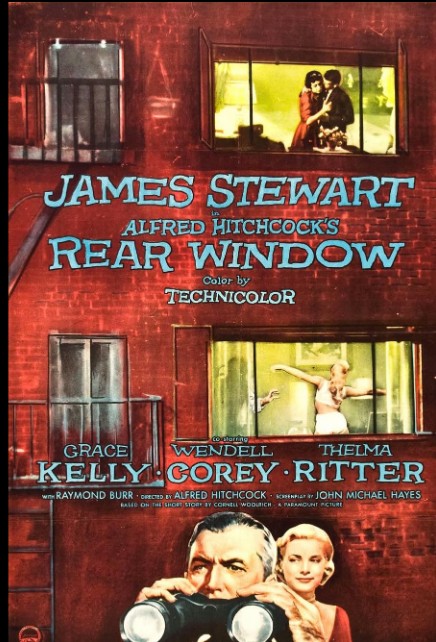
Rear Window (1954) – Classic

Genre: Suspense Thriller

Platform: Amazon Prime – Rent

Director: Alfred Hitchcock

Time: 1 hour 47 minutes

Cast:    James Stewart (L.B. Jefferies). Grace Kelly (Lisa Fremont). Thelma Ritter (Stella).  Wendell Corey (Tom Doyle). Raymond Burr (Lars Thorwald)

Plot:  Due to an accident in which his leg was fractured while capturing a motor race accident, photographer Jeffries is confined to his wheelchair for six weeks in an apartment. With nothing to do he observes the neighbourhood through his window and sees various stereotypes. He is convinced that the jewellery salesman in the opposite flat has murdered his invalid wife as he has seen him make mysterious trips in the middle of the night. His girlfriend Lisa and his physiotherapist Stella think he is crazy but soon they too are convinced that something is not right ….

From the early to the late 1980s, I was a member of a film club which showed all the ‘world masters’ such as Kurosawa, Ingmar Berman, Fellini etc . I innocently asked one of the society organisers why they do not show Hitchcock films. He gave me a look that was a cross between disgust and anger. When I persisted , he mumbled something about appropriate 16 mm prints being unavailable .

During the Red Lorry Festival in March this year, I attended the “Directors masterclass” by Sriram Raghavan. Amazingly he narrated a similar incident where during his FTII days, he was ticked off for requesting that Hitchcock films be shown and even included in film studies.  Hitchcock is more or less standard in most Western film schools while I am not sure whether it is taught in Indian film schools .

Because Rear Window remains an amazing example of the craft of film making.

Looking at the film today and judging by the audience response in a recent screening, the film still holds its own and is not at all dated. The audience response was EXACTLY the same as when I saw it three days in a row , forty years ago. A private screening at a friend’s place, the response was exactly the same with the audience letting out gasps at the same places as happened years ago.

So what is it that makes this CLASSIC?

The amazing set design? looking at how tightly the camera moves, it is impossible to believe that whatever Jeff sees from his point of view is actually one gigantic setting filled with amazing characters such as the struggling song writer, ‘Miss Lonelyhearts” – a single somewhat aged woman who is struggling to find a partner, Miss Torso – the well endowed ballet dancer who is trying to find the ‘right man’, a deaf sculptress, Thorwald the jewellery salesman mocked by his invalid wife, an aged childless couple who let down their pet dog every day by a basket , a newlywed couple who rarely open the window once they enter the nearby flat .  And so on.

As mentioned by Donald Spoto in his classic book The Art of Alfred Hitchcock, each of them represents the various possibilities that Jeff and Lisa may end up as – lonely,  embittered couple, childless couple ; as Jeff says “he would welcome trouble at this stage”. And boy does he get it.

Much more than the murder mystery angle is the totally sneaky way in which the film gradually peels away the layers and points out why we love films – basically we are all voyeurs! Stella clearly tells Jeff “we have become a race of peeping Toms; we should go out and take a good look at ourselves’. Since it happens in the film’s beginning most of us may miss that line but it is THE clear connection about film being nothing but scripted voyeurism!

This is sophisticated film making and as with any Hitchcock, the script crackles with wit , sometimes macabrely – when Jeff is about to eat his morning bacon breakfast, Stella looks at Thorwald’s flat and wonders aloud “where would he cut her up ? where could he have done it?’ Needless to say Jeff puts the bacon back on the plate.

Many moments like these pepper the film which remains easily among any top 10 Hitchcock films.

The final word –  WATCH IT  ANYHOW.

PS: With such a terrific story , its no wonder that many have tried to remake it . Some have succeeded while others remain meh! Here are the list of two remakes that I know of:

1. Rear Window (1998) – Christopher Reeve as a paralysed man confined to his wheel chair who is sure he has seen a murder; would love to watch to check out how it turned out. The film is available on You Tube!

2. Disturbia (2008) – A teenager confined to his home with an electronic locker on his foot, is sure he has seen a murder, in the neighboring home. Very gripping.

Script – 5 out of 5

Story – 5 out of 5

Direction – 5 out of 5

Photography – 5 out of 5

Total – 5 out of 5

One response to “Rear Window (1954) – Classic”

  1. Robin Bhat avatar
    Robin Bhat

    Hi Rammesh,

    Another great review! Yes, to some extent or another, we are all ‘voyeurs’ !

    A small bit of trivia, also from the Spoto book:

    “The movie begins as the credits appear over a slowly ascending bamboo shade. The view we finally see beyond the shade is the panorama of the largest indoor set built by Paramount Studios up to the end of 1953 – the array of apartments in the buildings surrounding Jeff”.

    The book goes on to explain how Hitchcock did his homework… the address of the apartment.. proximity to the police station… in the film, and in reality; this is not the first Hitchcock film where one can trace the local address/geography in the film to an actual map.

    (In contrast.. unlike typical Bollywood masala, where most murders/takedowns/police sirens end up – if a Mumbai setting at the Ballard Estate area or if New Delhi, the ‘Lutyens’ area)

    Any Hindi film remake of ‘Rear Window’ ?


    Lastly, very impressed at knowing that you attended the “Directors Masterclass” conducted by none other than masterclass director Sriram Raghavan! (Ikkis, Andhadhun, Badlapur, Johnny Gaddar…)


    Regards,,, Robin

Leave a Reply

Your email address will not be published. Required fields are marked *

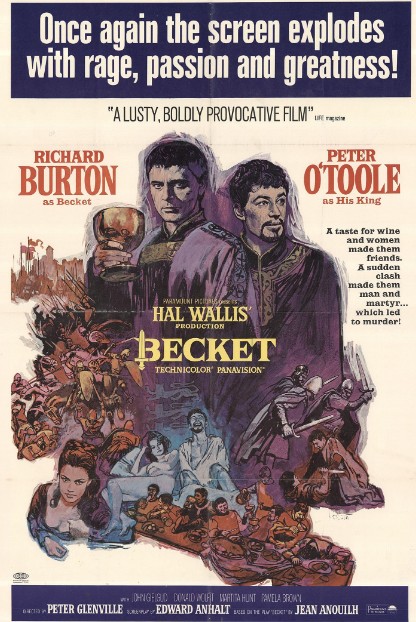
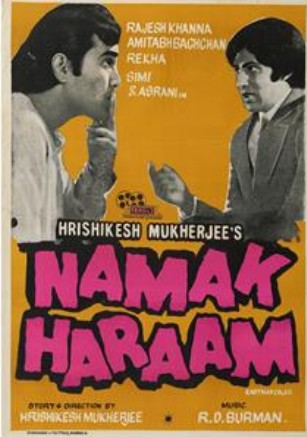
Becket (1964) and Namak Haram (1973) – One story Two Versions – again

When I was doing research for my book on Hrishikesh Mukherjee (Human Cinema available on Amazon on Kindle and Print ; for Amazon link, please click here http://bit.ly/4pnxUPL ), I came across this statement by Hrishida – “My film is not a copy of any foreign film; it is just a story of two friends one of whom doesn’t want to let go of the other”. If anything, Hrishida was very good at dissembling and diverting attention in a cheeky sort of way. He said similar things about Anupama (supposedly based on a cousin’s life story) and Abhiman (supposedly about one of his friends who had a problem with his wife and NOT any musical personalities’ personal lives).

When Namak Haraam was released, there was some loose talk about it being a direct copy of the 1964 English film Becket, updated for modern times. I can confirm that this supposed loose talk is more than true. The King becomes the Industrialist and the Head Priest/ Arch Bishop becomes the Industrial worker turned Union Leader. In both cases the King/ Industrialist places his friend in a position thinking that his “friend” would be his puppet. Predictably his friend, the supposed puppet, turns adversary, does what is morally right and not what is convenient for the King.

There is NO WAY that anyone can dismiss Namak Haraam as anything but an – er – inspiration of Becket. Yet, I find the Indianisation perfect and contemporary to the times in which it was set in. The early 1970s were filled with news of various industrial strikes across India due to labour unrest, fuelled by a perception that the ordinary industrial worker was not getting his dues and all the ‘profits’ from their labour were filling the coffers of their masters. The most famous or should we say infamous example of this was the textile strike of the late 1970s/ early 1980s that ultimately resulted in massive job losses and multiple textile mills in the area of Parel-Lower Parel-Mahalaxmi shutting down and never opening again. Today the land has been sold and most of them are made in to apartments or malls while the chawls in which the workers lived, still stand in their original semi dilapidated condition, cheek by jowl with the towers.

Coming back to Namak Haram. When it was released in 1973, the biggest indicator of Amitabh Bachchan’s rising stardom was as shown in the hair cutting salon which I used to visit. There was an “Amitabh cut”, complete with Amitabh’s photo and how the hairdressers would go about doing it.  This also was the second film in which Rajesh Khanna and Amitabh Bachchan worked together. Hrishida also said in an interview that he had to keep the ending a secret as both stars wanted mileage out of the ending. Amitabh was supposedly upset that he didn’t get to ‘die’ onscreen.

Vicky as a character is fascinating at best; he cannot give up his friend and he wants to childishly hold on to him despite growing evidence that Somu is a different human from the friend with whom he used to go drinking, chasing women and indulging in extravaganzas he couldn’t afford and he knows that everything is paid for, by Vicky. Somu ‘grows up’ from something of a ‘chamcha’ as his locality calls him, to a ‘planted union leader’ designed to break the stranglehold of Bipin Lal the Union leader, to finally a human who realises where his moral duty as a Union Leader lies, which is to fight for the labourer’s rights.  In contrast, Vicky remains the same embittered somewhat childishly selfish person he always was. Only Somu’s death makes him see the light and he promises to set things right.

Becket’s story is somewhat similar. Becket’s King is bothered by The Church which keeps questioning his authority and wants him to submit to it. So, what better way to control it than to have his friend, a priest, be made the figurehead Arch Bishop whom he can control? While he thinks He, The King, is the law, the Arch Bishop soon starts countering saying that there is a HIGHER LAW that has to be obeyed and soon both are at loggerheads with each other.

So, which is the better version? This is incredibly difficult to answer.

Becket is the longer film and has some moments which we cannot relate to, especially the religious and historical angle. From that context alone, Namak Haram is easy to relate to due to the Indian milieu in which it is set, the focus on the friendships and of course music which forwards the story. The side plot of the drunk poet is something that is not there in the original film but is a perfect example of the localisation that was done, leading to an interesting song situation, the totally melancholic Mai shaayar badnaam.  A fleeting shot of the dying poet looking at Bipin Lal’s daughter leaves us with a question – is she the woman who ditched him, leading to his alcoholism, and his sad smile is a final thank you? Such ambiguity is there in many of Hrishida’s films and we can make whatever meanings we want out of it.

Both films begin in the same way. In the Hindi film, Vicky released from prison, goes home and is confronted by the photo of a smiling Somu. In the English film, the King reaches a mausoleum where the death mask of the Bishop has been kept; the King starts questioning the death mask. So right from the first scene, we know both the characters are dead. Immediately the film cuts to the past with both of them running away from a young girl’s farm loft, while being chased by the girl’s parents. Similar scene in the Hindi film except that in keeping with th1 1970s, the two work in a law firm and sketch their boss’s female secretary.  

Finally. Which is the better film? No. I am not going to answer that question but let you judge for yourself.

I would rate BOTH versions 5 out of 5 for direction, screenplay, dialogues and superb performances from the leads, namely Richard Burton and Peter O’Toole in the English original; Rajesh Khanna and Amitabh Bachchan in the respective Hindi roles.

Both films are free on You Tube

Namak Haram is free on You Tube https://youtu.be/2aZaJjoFFl8?t=2

Becket is free on You Tube  https://youtu.be/LMwgMDUjVf0?t=4

PS: I NEVER got an Amitabh haircut 😊

One response to “Becket (1964) and Namak Haram (1973) – One story Two Versions – again”

  1. Robin Bhat avatar
    Robin Bhat

    Hi Rammesh,

    Beautiful, side-by-side look at two classic films!

    I would say that Namak Haram is easily the more relatable film to the Indian movie-goer.

    Beckett is also a gem, with three huge actors (Peter O’Toole, John Gielgud and Richard Burton)… but unless one is deep into Henry II and his era (1154-1189), there is little context to the film., except for the titanic encounter of State vs. Religion. (a struggle resonating the news as recently as yesterday, July 4).

    Naram Haram was in the hotbed of Indira’s India, the times when ‘Garibi Hatao’ became an empty slogan, and the unfortunate mill workers of Parel (Mumbai), became pawns in a ruthless war (the union strike, Datta Samant, etc.). Deewar was set in the same general time, and VInay Lal’s book on that film covers the same terrible angst of India (and Bombay’s) youth.

    Only some points to add on Namak Haram:

    1. This is the second (first being Buddha Mil Gaya) of ten (?) collaborations with R. D. Burman. Four solos for Kishore Kumar in Namak Haram, and, IMO, one of the very best of the RDB-Anand Bakshi efforts seen in ‘main shayar badnaam’.

    Though probably having heard the others maybe a thousand times, the one I love is the evergreen election song! ‘Woh jhootha hai’ is a number that is useful every few months.

    (Not ashamed to admit that only a few years ago, I voted for a local politico, who did get elected, but is now in prison. LOL!)

    2.
    Small, but important footnote. This was Gulzar’s second back-to-back Filmfare Award for Best Dialog – first Anand, then Namak Haram.

    3.
    A nod to Om Shivpuri for his role as wily father/factory owner.

    4. Asrani was nominated for Best Comedian.

    Lastly, I always a chuckle at Hrishida and Amitabh flaunting for us the ‘tech toys’ of that era – a spool recorder… a video camera!


    Thanks….. Robin

Leave a Reply

Your email address will not be published. Required fields are marked *