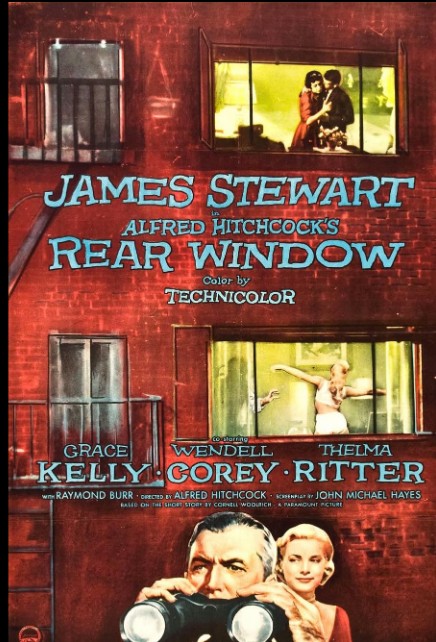
Rear Window (1954) – Classic

Genre: Suspense Thriller
Platform: Amazon Prime – Rent

Director: Alfred Hitchcock

Time: 1 hour 47 minutes

Cast:    James Stewart (L.B. Jefferies). Grace Kelly (Lisa Fremont). Thelma Ritter (Stella).  Wendell Corey (Tom Doyle). Raymond Burr (Lars Thorwald)

Plot:  Due to an accident in which his leg was fractured while capturing a motor race accident, photographer Jeffries is confined to his wheelchair for six weeks in an apartment. With nothing to do he observes the neighbourhood through his window and sees various stereotypes. He is convinced that the jewellery salesman in the opposite flat has murdered his invalid wife as he has seen him make mysterious trips in the middle of the night. His girlfriend Lisa and his physiotherapist Stella think he is crazy but soon they too are convinced that something is not right ….

From the early to the late 1980s, I was a member of a film club which showed all the ‘world masters’ such as Kurosawa, Ingmar Berman, Fellini etc . I innocently asked one of the society organisers why they do not show Hitchcock films. He gave me a look that was a cross between disgust and anger. When I persisted , he mumbled something about appropriate 16 mm prints being unavailable .

During the Red Lorry Festival in March this year, I attended the “Directors masterclass” by Sriram Raghavan. Amazingly he narrated a similar incident where during his FTII days, he was ticked off for requesting that Hitchcock films be shown and even included in film studies.  Hitchcock is more or less standard in most Western film schools while I am not sure whether it is taught in Indian film schools .

Because Rear Window remains an amazing example of the craft of film making.

Looking at the film today and judging by the audience response in a recent screening, the film still holds its own and is not at all dated. The audience response was EXACTLY the same as when I saw it three days in a row , forty years ago. A private screening at a friend’s place, the response was exactly the same with the audience letting out gasps at the same places as happened years ago.

So what is it that makes this CLASSIC?

The amazing set design? looking at how tightly the camera moves, it is impossible to believe that whatever Jeff sees from his point of view is actually one gigantic setting filled with amazing characters such as the struggling song writer, ‘Miss Lonelyhearts” – a single somewhat aged woman who is struggling to find a partner, Miss Torso – the well endowed ballet dancer who is trying to find the ‘right man’, a deaf sculptress, Thorwald the jewellery salesman mocked by his invalid wife, an aged childless couple who let down their pet dog every day by a basket , a newlywed couple who rarely open the window once they enter the nearby flat .  And so on.

As mentioned by Donald Spoto in his classic book The Art of Alfred Hitchcock, each of them represents the various possibilities that Jeff and Lisa may end up as – lonely,  embittered couple, childless couple ; as Jeff says “he would welcome trouble at this stage”. And boy does he get it.

Much more than the murder mystery angle is the totally sneaky way in which the film gradually peels away the layers and points out why we love films – basically we are all voyeurs! Stella clearly tells Jeff “we have become a race of peeping Toms; we should go out and take a good look at ourselves’. Since it happens in the film’s beginning most of us may miss that line but it is THE clear connection about film being nothing but scripted voyeurism!

This is sophisticated film making and as with any Hitchcock, the script crackles with wit , sometimes macabrely – when Jeff is about to eat his morning bacon breakfast, Stella looks at Thorwald’s flat and wonders aloud “where would he cut her up ? where could he have done it?’ Needless to say Jeff puts the bacon back on the plate.

Many moments like these pepper the film which remains easily among any top 10 Hitchcock films.

The final word –  WATCH IT  ANYHOW.

PS: With such a terrific story , its no wonder that many have tried to remake it . Some have succeeded while others remain meh! Here are the list of two remakes that I know of:

1. Rear Window (1998) – Christopher Reeve as a paralysed man confined to his wheel chair who is sure he has seen a murder; would love to watch to check out how it turned out. The film is available on You Tube!

2. Disturbia (2008) – A teenager confined to his home with an electronic locker on his foot, is sure he has seen a murder, in the neighboring home. Very gripping.

Script – 5 out of 5

Story – 5 out of 5

Direction – 5 out of 5

Photography – 5 out of 5

Total – 5 out of 5

One response to “Rear Window (1954) – Classic”

  1. Robin Bhat avatar
    Robin Bhat

    Hi Rammesh,

    Another great review! Yes, to some extent or another, we are all ‘voyeurs’ !

    A small bit of trivia, also from the Spoto book:

    “The movie begins as the credits appear over a slowly ascending bamboo shade. The view we finally see beyond the shade is the panorama of the largest indoor set built by Paramount Studios up to the end of 1953 – the array of apartments in the buildings surrounding Jeff”.

    The book goes on to explain how Hitchcock did his homework… the address of the apartment.. proximity to the police station… in the film, and in reality; this is not the first Hitchcock film where one can trace the local address/geography in the film to an actual map.

    (In contrast.. unlike typical Bollywood masala, where most murders/takedowns/police sirens end up – if a Mumbai setting at the Ballard Estate area or if New Delhi, the ‘Lutyens’ area)

    Any Hindi film remake of ‘Rear Window’ ?


    Lastly, very impressed at knowing that you attended the “Directors Masterclass” conducted by none other than masterclass director Sriram Raghavan! (Ikkis, Andhadhun, Badlapur, Johnny Gaddar…)


    Regards,,, Robin

Leave a Reply

Your email address will not be published. Required fields are marked *

The Lady Vanishes – Two equally good versions

It is always a mixed blessing when watching remakes of an original, especially when the original has the “Master of suspense”, Alfred Hitchcock’s stamp in various scenes. As always, Hitchcock’s “suspense movies” have one twist after the other, making you wonder what is the “MacGuffin” – the crux/ the core idea of the story.  There are three versions of this story, two of which are available on You Tube. The 2012 version seems to be unavailable on any online platform in India (though available on Amazon Prime USA).


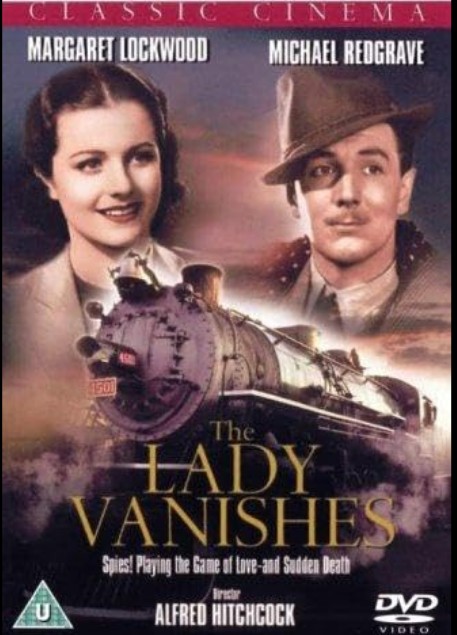
The Lady Vanishes (1938)

Genre: Mystery/ “Spy Adjacent” thriller

Platform: You Tube

Time: 1 hour 35 minutes

Director: Alfred Hitchcock

Cast: Margaret Lockwood (Iris Henderson). Michael Redgrave (Gilbert Redman). Paul Lukas (Dr. Egon Hartz). May Whitty (Miss Froy).


Plot:    Musicologist Gilbert Redman and Iris Henderson have had multiple feuds before they board a train in a European country Bandrika. Gilbert who has been around to document Bandrika’s folk music is clearly skeptical but is slowly convinced that there really was a Miss Froy, who had helped iris, when a brick , intended for Miss Froy, fell on her head, leading to everyone concluding that she is suffering the after effects of the ‘head injury’. Iris wonders why everyone is lying about not seeing Miss Froy, with whom she had been friendly. Iris suspects that there is some kind of conspiracy afoot to kidnap Miss Froy who isn’t someone she claims to be, a humble governess…

The film was entirely shot in studio and it is evident in the way most of the scenes have that ‘studio’ feel. That said, it is still one of the most playfully written screenplays by Hitchcock’s constant collaborator and wife, Alma Reville. There is an overall feeling of pulling the viewer by the nose and pointing in different directions. We know that everyone except Iris is clearly in on “some conspiracy” but we do not know what. The plot steadily accelerates to its climatic shootout and the bold and daring escape from “Bandrika” to “Switzerland”. Most of us can’t be sure whether the kindly, somewhat eccentric old woman could be a spy and she denies being one too but we are not too sure. The end reveals otherwise.

There are enough pointers to the “Hitchcock touch” – such as the huge close up of a mysterious hand slowly moving the brick to target Froy but which instead falls on Iris’s head. The supposedly spiked drinks which  the duo are about to drink where the glasses are in the foreground which we the audience know but not the unsuspecting lead duo. A mysterious ‘conjurer’ who almost kills the leading duo but after a few moments, smiles happily his way past the leading duo, leading the doctor to suspect that Iris has been suffering serious delusions; and so on.

For its time, Iris is shown as a somewhat ‘bold’ woman whose ideas of marriage are not exactly conventional as she hints at flings and is finally setting for matrimony with a supposedly straight but dull man. There are two cricket mad fanatics who are only intent on reaching England for a crucial test match and to hell with all the people on the train, including the missing woman and the “young woman making up a devil of a fuss”.  These are pre-WW2 Englishmen who are straight and narrow and will always do the right thing for England, come what may. There are also a couple on an illicit affair where the man doesn’t want to be found out as he is a judge. The film is an overall delightful film that has the right mix of suspense punctuated by peppy crackling dialogues and Free on You Tube

Script – 5 out of 5

Story – 4 out of 5

Direction – 5 out of 5

Photography – 5 out of 5


Total – 4.8 out of 5


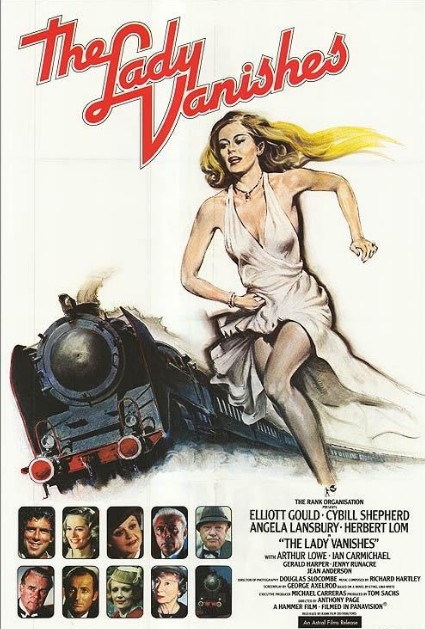
The Lady Vanishes (1979)

Genre: Mystery/ “Spy Adjacent” thriller

Platform: You Tube

Time: 1 hour 39 minutes

Director: Anthony Page

Cast: Elliott Gould (Robert Condon). Cybill Shepherd (Mrs Amanda Kelly). Angela Lansbury (Miss Froy). Herbert Lom (Dr. Egon Hartz).

Plot:   American heiress Mrs Amanda Kelly is treated sympathetically by Miss Froy, due to her drinking antics ending up with a severe hangover, when they board a train in Nazi Germany. When Amanda wakes up from a nap in her compartment, everyone in the compartment denies ever seeing Miss Froy. Newspaperman Robert Condon is sure that this is a case of some kind of hangover inspired by Kelly’s binge drinking and also with Dr. Hartz’s suggestions that this could be due to Kelly’s antics the previous night, where her effort to mimic Hitler had met with the local SA’s displeasure who had literally thrown her overboard from the table where she was strutting. Kelly is sure that she has seen Miss Froy and something bad has happened to her…

When I saw this film on its initial release, at Sterling theatre, I was unaware that this was a remake of the Hitchcock film and enjoyed it. Years late I became aware of the original when I bought Donald Spoto’s book on Alfred Hitchcock. Sometime in the 1990s I saw the “original” and was pleasantly surprised how much the original and this color version were alike, almost to the point of being a scene by scene, shot by shot and even some line-by-line remake of the 1938 film. So; does it succeed? Admirably so.

There is a lightweight touch to the overall proceedings including keeping the same characters as the original, especially the cricket mad duo Charters and Caldicott. Then there is the illicit couple on an illicit weekend and other multiple characters. The film is tailored to then rising star Cybil Shepherd’s reputation as a ‘comedienne’ and she is excellent as the loud American heiress. Her comic timing more than makes up, to keep the overall atmosphere lightweight. The musicologist is replaced by a Life magazine photographer thus making both the lead characters American, to appeal to a larger (= American) audience while keeping the peripheral characters British. Nazi Germany is explicitly mentioned and lest someone thinks otherwise, there are enough shots of German soldiers and finally an SS officer in his all-black uniform, leaving no doubt that this is Nazi Germany and surely poor Miss Froy must have some vital secret about the upcoming war.

There are some superb shots of the “German train”, traversing the “German Bavarian landscape” – all the train scenes were shot in Austria and the Austrian Railways are thanked at the film’s ending. Since Shepherd has the better written role, she gets more time onscreen and like the original, she (and most other characters on the train), wear the same dress throughout the film which is free on You Tube

Script – 4 out of 5

Story – 4 out of 5

Direction – 4 out of 5

Photography – 4 out of 5

Total – 4 out of 5

1 comment on The Lady Vanishes – Two equally good versions