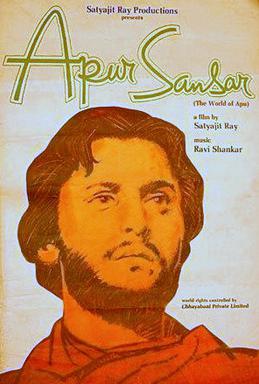
Apur Sansar (1959) – Classic / Apu Trilogy part 3

3–5 minutes

Genre: Human Drama

Platform: Free on You Tube with English subtitles

Time: 1 hour 50 minutes  

Director: Satyajit Ray

Cast:   Soumitra Chatterjee (Apurba “Apu” Kumar Roy). Sharmila Tagore (Aparna Roy, Apu’s wife). Swapan Mukherjee (Pulu, Apu’s friend). Dhiren Ghosh (Apu’s landlord). Dhiresh Majumdar (Sasinarayan, Aparna’s father). Alok Chakravarty (Kajal Roy, Apu and Aparna’s son).

Plot: Apu quits college in Inter and wishes to find a job. He and his friend Pulu go to Pulu’s village to attend his cousin Aparna’s wedding but Apu ends up getting to Aparna, since the groom turns out to be mentally unstable. Apu brings Aparna to Calcutta and she is appalled at his existence in a single room atop a tenement. Soon she adjusts and they find married bliss in their simple existence where she manages the home and he earns money by giving tuitions. Aparna goes back to her native village and dies at childbirth…

Spoiler Alert:

Let me start with the film’s last scene / ending; working backwards, (hopefully) the essence of this human story becomes clearer.                              

Apu’s estranged 5 year old son Kajal: Tumi Kaun (who are you)?

Apu: Aami tomar bandhu (I am your friend)

Life has come full circle for Apu. Hope. to Confidence. to Love. to Anger and Despair. And once again Hope.

From being an orphan, to a student, to a married man who loses his wife at childbirth and finally becoming a friend to his five-year-old son who is running wild, (since the child lacks any kind of authority figure to ‘control’ him), Apu has undergone the full life cycle, while still in his 20s.

At the film’s beginning, Apu sets out to get a job. His college professor wishes that he continues his studies but Apu is clear that lack of money prevents him from continuing his science education. On a journey to his friend Pulu’s native town Khulna, Pulu reads Apu’s novel and urges him to get it published but fate has other plans in the shape of Pulu’s young teenage cousin Aparna, played with incredible absolute confidence by a then 15-year-old Sharmila Tagore, who Apu is forced to marry out of a sense of saving the girl’s honor and future.

Losing her to the rigors of childbirth. Losing interest in life. Working in a remote mine and sending money to his father-in- law to take care of Kajal. Apu’s overall depression and anger is brought out well in these scenes. He is bitter that life has dealt a bad hand to him . So much that he even doesn’t want anything to do with his son.

Once again it is Pulu’s intervention that proves critical. Pulu brought him to the marriage and Aparna. It is Pulu again who traces the child Kajal and the father Apu, and brings them together. Pulu’s job is over. Will Kajal and Apu live as father and son? The answer is provided by Apu himself to Kajal ; aami tomar bandhu.

In my view this is an ideal conclusion to the story which is actually from the second half of the novel Aparajito. The full circle of life that started with Apu’s birth and his journey till date is known to us . Aparna’s death acts as one more among the many blows that life has dealt him. Yet he comes out of it and despite not knowing what the future holds, he moves on with his ‘bandhu’. As to what Apu and his “bandhu’ will do in the future and what life holds for them is left to our imagination.

Lyrical is the word that frequently comes to my mind while watching the film. The pace is even and the third film of the trilogy shows Ray , the master observer of human emotions, in complete command of the medium. Be it a small river in rural Bengal or a dank tenement near a railway yard, the images that leap out of the screen onto us show the realities of life as seen by Apu (and by us). Subrata Mitra’s cinematography again shows the contrast between the peaceful rural areas and Apu’s somewhat harried life in his one room rooftop tenement that is open to the elements. The film also began Ray’s long association with Soumitra Chatterjee who remained his preferred lead actor well into the 1980s, acting in 14 of Ray’s films, in varying roles.

As the end titles appear, we wish that there had been more about Kajal and his bandhu and we could have known more about them and what happened to them. This is easily the most perfect film of the trilogy and a classic by any definition.

The film is free on You Tube

Script – 5 out of 5

Story – 5 out of 5

Direction – 5 out of 5

Photography – 5 out of 5

Total – 5 out of 5

No comments on Apur Sansar (1959) – Classic / Apu Trilogy part 3
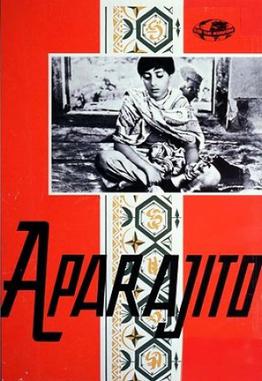
Aparajito (1956) – Classic / Apu Trilogy Part 2

3–4 minutes

Genre: Human Drama

Platform: Amazon Prime / You Tube Free

Time: 1 hour 50 minutes  

Director: Satyajit Ray

Cast:   Kanu Banerjee (Harihar Roy). Karuna Banerjee (Sarbajaya Roy). Pinaki Sengupta (young Apurba “Apu” ). Smaran Ghosal (Apu – adolescent). Ramani Ranjan Sengupta (Apu’s great uncle).

Plot: Apu’s father Hairhar is still struggling to make ends meet with his wife Sarbajaya, in Varanasi where they had shifted. Young Apu is just wandering around, playing with neighboring kids. Hari dies and an uncle helps them to return to a village so that Apu can take up the family tradition of priesthood. Apu however in interested in studying and proves to be a bright student, winning second prize in the district due to which he gets a chance to study in Calcutta. Sarbajaya is fearful but the adolescent Apu wants to learn science and goes off to Calcutta where he works in a printing press at night while studying in a college during daytime, struggling to balancing sleep, studies, friendship and money…

This is the second Apu story, written by novelist Bibhutibhushan Bandopadhyay. This is also an unusual film from Ray in that it shows that Apu is not all that loyal to his parents, especially later to his struggling mother and even insensitive to her loneliness and pain – totally in contrast with how children were always shown loyal in various Indian language films. Apu emerges almost as ruthlessly selfish as befitting any teenager who thinks only about himself and doesn’t care what’s happening in his village home. Sarbajaya’s longing look at the distant railway tracks every time a train passes on the horizon, speaks volumes about her feelings than any long sets of dialogues can say or mean.

Apu is also discovering a world beyond his supposedly simple village life – the complexity of living in a city, earning his bread, paying his rent and studying. The professor who discovers Apu sleeping in the class and sends him out reminded me of one of my school principals who would rarely speak but just gesture with his fingers – as the onscreen professor does 😊.

Apu’s disinterest in priesthood and leanings towards science also makes a subtle point about how Apu looks at the world. His constant twirling of the small globe, which he carries around, shows a desire to go beyond his small world and look for adventures beyond his own world. He finds it in multiple ways and especially as a student, who is forced to balance his life between his village / mother, his studies, his job, and generally dealing with life. As mentioned earlier, Apu emerges as a somewhat selfish person, who thinks only about himself. Sarbajaya’s lonely death, shown in multiple cuts with her gradually fading away, cuts the last bond which Apu had with the village. Though he regrets not being there in her last moments, he tells his uncle that he will perform her last rites in Calcutta and leaves everything behind . He is now a full-fledged city man, awaiting new adventures beyond his limited world view.

Once again Subrata Mitra’s outstanding cinematography deserves a special mention. Be it the Varanasi ghats or lanes, or a steam train on the horizon as seen by Sarbajaya, almost everything leaps off the screen in utter crisp clarity.

To me, the film looks is a bit underwhelming. Maybe its the second film in a trilogy where everything is yet to develop and we do not know what Apu will grow into, since Apu is trying to find his place in the world – exactly like Ray, with his second film was trying to do so. Despite my misplaced feelings, the film cant be faulted in its story of a boy growing into a teenager and suddenly encountering the world and becoming a man.

The film is on Amazon Prime and FREE on You Tube . You tube link as below:

https://youtu.be/scgyxNLiAL8?t=35


Script – 5 out of 5

Story – 4 out of 5

Direction – 5 out of 5

Photography – 5 out of 5

Total – 4.8 out of 5

2 responses to “Aparajito (1956) – Classic / Apu Trilogy Part 2”

  1. Robin Bhat avatar
    Robin Bhat

    Hi Rammesh,

    Just an aside on Subrata Mitra:

    His entry at Wikipedia is worth reading, as it relates to the pioneering use of ‘bounce lighting’ in the Satyajit Ray films.

    On the Hindi film side – Teesri Kasam.

    IMHO, never has Waheeda Rehman looked as majestic as she does in this film, thanks to the lens of Subrata Misra.

    An ace cinematographer such as him (and a select few in the Indian Film Industry) demonstrate to us that it is in accurate to call it a ‘black-and-white film’.

    Their masterworks use two primary colors: pure black and pure white… and the infinite number of fractional color values between them, beyond what the human eye can decipher.

    Thanks,

    Robin

    1. Rammesh avatar
      Rammesh

      Robin

      Thanks. Will check it out . As a rule I try NOT to check ANY reference site, (at the most imdb for the artist names) lest it interfere with what I have to say ;).

      Now that you have mentioned it, I will check it out. Thanks again.

      KVR

Leave a Reply

Your email address will not be published. Required fields are marked *

Pather Panchali (1955) – Classic / Apu Trilogy part 1

4–6 minutes

Genre: Human Drama

Platform: Amazon (Rent) You Tube Free

Time: 1 hour 50 minutes  

Director: Satyajit Ray

Cast:   Kanu Banerjee (Harihar Roy). Karuna Banerjee (Sarbajaya Roy). Subir Banerjee (Apurba “Apu” Roy). Uma Dasgupta (Durga Roy). Chunibala Devi (Indira Thakrun, the old aunt).

Plot: Apu is born to a poor priest Harihar, who is struggling to make ends meet with his wife Sarbajaya, and their daughter Durga. His wife resents the presence of an old aunt, who she feels is spoiling her daughter. Hari goes out of the village to multiple towns to earn money while Apu grows up in the village, learns about village life and sees the world through his innocent eyes. Sarbajaya worries about the lack of food, money and news of Hari…

The story by novelist  Bibhutibhushan Bandyopadhyay was published in 1929. The film places the events in the same time period and has a total rural ambience including practices of the rural areas such as a village play (jatra), child marriage of girls who are generally uneducated , being married off at a very early age and an overall sense of rustic peace which will be surely broken by some kind of calamity.

The overall atmosphere is hardly doom laden but is filled with innocence as Apu sees the world through his eyes and cannot understand why his mother is slaving all the time , cooking, generally helping around while his elder sister Durga is playing with girls of her age . There are minimal dialogues as everything is visual , as Apu sees it. There are no cliches that one expects of films set in rural areas, such as the bad zamindar, the sly/ sympathetic priest , and so on. The village mostly has women doing all the hard household work. The men are barely seen.

Hari is essentially an optimist who feels that “the city’ will have more money and wants to try his chance there. With his meagre belongings he goes off to the city and thus starts Sarbajaya’s agony – not knowing what’s happening. The rare letter that arrives is usually rushed by Apu crying out aloud the arrival of a ‘chitti’.  That the family can read is attributed to Hari being a Sanskrit teacher and helping his family to read, while composing stories and poems .

The supposedly simple village life is not all that simple as it appears to be. Sarbajaya is losing both her mental peace and must borrow money, leading to taunts and pressure from her lenders, to pay up or else. The expected tragedy as and when it happens is something that no one is prepared for. Apu also can’t understand what’s happening except that he sees his elder sister is not around any more . Durga’s death attains a more poignant tone when Hari returns with money from his various city jobs, including clothes for the family and learns of Durga’s death.

The final shot shows that Hari has had enough of the sufferings in his village and is leaving his village for the city. A snake entering Hari’s derelict broken house is the symbol that the house is inhabitable for humans. Its amazing that as early as 1929, someone had addressed the essential reason for migration from a simple rural life to an existence in a harsh uncaring city. The stage is set for part 2 and part 3 of the trilogy.

Overall the feeling of the film is like a blank canvas on which colours and shades are slowly filled. The poverty is not bleak but somehow the couple manage and finally throw in the towel. They may have been defeated for the time being but there are new adventures ahead, as seen through Apu’s eyes.

The simplicity of the film lies in its essence of everything seen through Apu’s eyes. Especially the scene where Apu and Durga rush to a railway line to see a train pass through as they have only heard its whistle and never seen it at close quarters. One of Durga’s friends being married off has its own poignancy as Durga also feels that maybe its time for her too. Durga is also accused of stealing a necklace from one of her friends but which is not found by anyone until much later , Apu finds it and quietly disposes it off at a nearby pond, thus cementing his jump from childish innocence to semi adulthood.

Personal Note: For me the village scenes, with the children running around, brought back vivid memories of my summer holidays, in my father’s village . It was his elder brother’s huge property which grew lots of vegetables and fruits . I and my cousins would run around plucking fruits or throwing stones at semi ripe mangos so that we could catch and eat them. It was a carefree time, and I can relate to Apu’s views of the village life.

The film wouldn’t be what it is , if not for the absolutely stunning photography by Subrata Mitra which shows every leaf, plant, dew drop and tree in exquisite sharp detail. The depth of focus is amazing in the long shots.

Overall this is a film that is a sure classic about the beginnings of Apu’s journey into adolescence, into adulthood and facing the thing called life.

Script – 5 out of 5

Story – 5 out of 5

Direction – 5 out of 5

Photography – 5 out of 5

Total – 5 out of 5
5 responses to “Pather Panchali (1955) – Classic / Apu Trilogy part 1”

  1. Ram avatar
    Ram

    Why No mention of Chunibala Devi as Indir Thakrun- who was a scene stealer-

    1. Rammesh avatar
      Rammesh

      Mentioned in passing as “old aunt”

  2. Robin Bhat avatar
    Robin Bhat

    Hi Rammesh,

    Loved reading your review.. will await the next installments of your review of these delicate masterworks.

    (small aside – I once did make the error of watching all three films in a single afternoon… mistake…. in the middle of the third film (Apur Sansar), was simply overwhelmed and left the theatre… (though, I have seen the films separately in the past, and do have the Blu-ray editions)

    Criterion Collection:
    “…shot over the course of five years, and each stands on its own as a tender, visually radiant journey. These films—which have risen from the ashes in meticulously reconstructed restorations, after the original negatives were burned in a fire—are among the most achingly beautiful, richly humane movies ever made.”

    ___
    Best part of your review was your personal note… unrelated (sort of), but immediately reminded me of:

    Aayaa hai mujhe phir yaad vo zalim
    Guzara zamana bachapan ka
    Haay re akele chhod ke jana
    Aur na aanaa bachapan ka……

    Vo khel vo saathi vo jhule
    Vo dod ke kehanaa aa chhu le
    Ham aaj talak bhi na bhule
    Vo khwaab suhana bachapan ka…….

    Mil kar roye fariyad kare
    Un bite dino ki yaad kare
    Ai kash kahi mil jaye koi
    Vo mit purana bachapan ka

    —
    Regards,

    Robin

  3. Lalitha Ravindran avatar
    Lalitha Ravindran

    I like your practice of rewatching films you had seen in childhood again and recording your impressions. Apu Trilogy is truly a classic from a master filmmaker.

    1. Rammesh avatar
      Rammesh

      Hi Lalitha

      Indeed. What was dull is now refreshing . Guess its a matter of perspective that improves with age :)

      KVR

Leave a Reply

Your email address will not be published. Required fields are marked *

Secret Service (2026) – Superb

Genre: Spy Thriller

Platform: Amazon Prime – paid (thru BBC Player)

Time: 5 episodes x average 45 minutes

Cast:  Gemma Arterton (Kate Henderson). Rafe Spall (Stuart Henderson). Alex Kingston (Rose Trewen). Galaxie Clear (Fiona Henderson). Avi Nash (Ravindra “Rav” Sangvhi). Mark Stanley (Ryan Walker,  MP and Foreign Secretary). Alexander Terentyev (Sergei Malinski, SVR operative).

Plot:  Kate Henderson is an SIS officer tasked with surveillance of a Russian Oligarch Mikhail Borodin who finances SVR operations. Kate persuades Lena, Borodin’s nanny to bug Borodin’s yatch in Malta, in exchange for political asylum for her and her brother. She and her colleague Avi hear Borodin and SVR officer Sergei. discuss the upcoming resignation of the Prime Minister due to health reasons. When the PM’s resignation resignation is announced, the duo are sure that there is a high level Mole in the Cabinet or somewhere in the higher offices of the Government…

Right from the word go, the series is superb and taut, with hardly any time wasted on establishing the characters. She is an MI6 officer and that means that half the time she cant talk about her job at home, except to her husband, who works with the Home Secretary and is aware what she is doing. The leak clearly points out that there is a high level mole and it is this high level mole hunt that takes up most of the time. The obvious candidate is the ambitious shit of a Foreign Secretary who is hardly modest and is clearly arrogant about his plan to move to No.10 Downing Street, health issues of the earlier PM be damned and uses every dirty trick in the book to foil the chances of the other incumbents for the PM’s post.  So like anyone investigating the higher ups, Kate has to tread very carefully.

The mechanics of the investigation along with the “I don’t care a damn” behavior of the Foreign Secretary point him out as the obvious suspect. The inconclusive final shot shows he still may or may not be the SVR mole.

Unfortunately the Series has couple of cliched stereotypes and anyone who watches films or TV series with a female protagonist knows that the lead character will have “family problems” , usually meaning a rebellious teenaged daughter. I do not know why this stupid trope is being repeated in series after series so much that we can predict how the daughter will ‘go straight’ once she hears what her mother is doing for a living – in this case defending Queen and Country. Naturally the mother says “its not James Bond and I rarely carry a gun” and so on.  Again, naturally, when we learn the identity of the Mole, we are really surprised how that turned out to be.

International locations add to the overall stylish look of the TV series . Hopefully Kate Henderson will return as she is based on a book trilogy written by writer Tom Bradby who has a cameo as a TV presenter , discussing the shenanigans of the Cabinet.

This is as taut as they come and even allowing for the cliched “family life’, couple of chases and one scene of gunplay, it is still a superb absorbing series and at 5 episodes , hardly takes up one’s time.

Highly recommended.

Script – 5 out of 5

Story – 4 out of 5

Direction – 5 out of 5

Photography – 4 out of 5

Total – 4.5 out of 5

5 comments on Secret Service (2026) – Superb

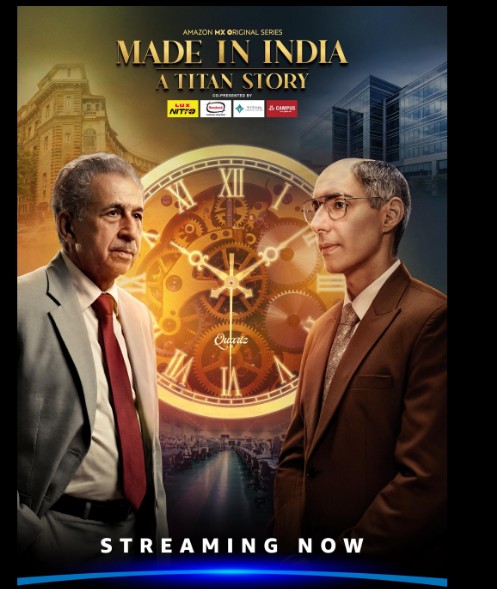
Made in India_A Titan Story (2026) – “Sweet and Fully filmi Fun”

Clickable links in red

Genre: Based on a True Story – Business

Platform: Amazon Prime

Director: Robbie Grewal

Time: 6 episodes x 50 minutes average

Cast:    Naseeruddin Shah (JRD Tata). Jim Sarbh (Xerxes Desai). Vaibhav Tatwawadi (Akash Bansal). Kaveri Seth (Megha Mhatre). Lakshvir Saran (Gaurav Dhar).

 Plot:  Surprised to discover that watch smuggling is a major activity due to the lack of any credible Indian brand of high quality, Xerxes Desai puts a proposal to manufacture high quality watches in India, to his mentor and friend J.R.D. Tata, the head of the Tata group, who is amused but doesn’t say anything. While on a visit abroad to explore the possibilities, JRD faces a personal insult by a Swiss precision watch manufacturer about India being unable to make any such high-quality precision watch. On his return, JRD gives the green signal to Xerxes. Desai gathers together a team that ultimately becomes the core group – Akash, Gaurav, Megha – that starts the process of setting up and manufacturing precision quartz watches with the Tata stamp of quality and dependability...

As a thumb rule, I avoid “sports movies”, “business success movies” as we know that the hero/ main protagonist will win in the end against all obstacles, hurdles, challenges, etc. He will be the one who will have multiple brainwaves while all the others around him / her stare at the sky and are motivated by the protagonist’s zeal and burning desire to bring forth the final result.  He/ she will overcome all personal and professional challenges with or without the support of people in his life. He / she is usually a very scrupulous/ honest person who follows all the rules of business and life . The Founder was probably the only film to break the rule as it showed Ray Kroc as a complete shit who stole the McDonalds brand name from the McDonald brothers, so much that they had to close their original restaurant and were unable to use their own name. ( Check out my take on The Founder at this link ).

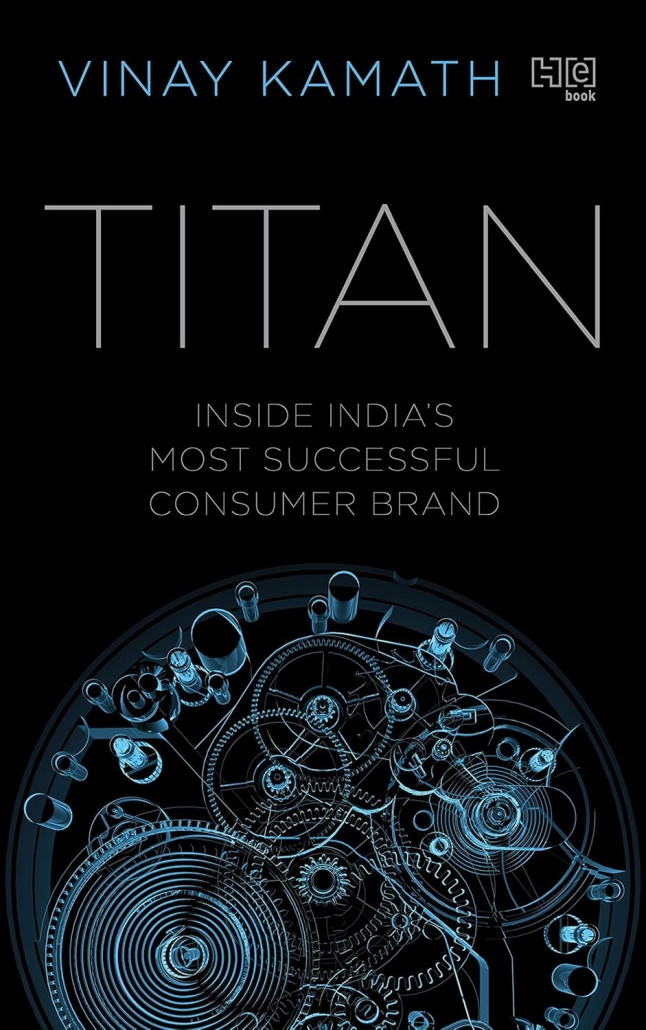
This TV Series also follows this “business success story” template except that the core team is also shown contributing to the overall success story of Titan watches. This is not Xerxes ‘Zee’ Desai’s lone battle but that of his core team too who are as fired up as ‘Zee’ to get the final product into the Indian market, while facing multiple challenges.  So how much of this story is true? That will be the question on everyone’s lip, before starting the series. I like the series and since I have read the book, let me answer my own question in a fun way. Two of the five main characters in the TV series are “real” – Xerxes Desai and J.R.D. Tata. The rest are fully filmi composite characters (If you read the book, then you will know the real history).

Then why on earth was I smiling throughout the six episodes? Why on earth did I laugh out aloud at some of the silly, theatrical even ‘filmi’ devices in the story – like JRD himself refusing to wear a watch till the time Titan makes its first watch? And why on earth did I want to know what will happen next – so much that I almost binge watched the series?

Simple. Because of the emotional connect that the writing generates. Unlike all ‘foreign’ business success stories, this one has its heart in the right place, especially the constant references to an era when ‘smuggled watches’ were a sign of prestige and ‘local watches’ were generally ridiculed being a poor second cousin / okay quality. My personal experience will probably give a perspective, especially to those who were – er – not around in that era.

Sometime in my final year of college, 1980, I was presented an HMT Ajeeth watch with a green dial ( HMT is referred to as GMT in the TV series; click on the link to see how it looked). Now a watch itself was a prestige symbol, and a long-lasting watch, even more so (my father had the same mechanical watch for almost 40 years) and an HMT watch with its wide range was even a bigger prestige. On a visit to Singapore in 1982, I bought a Casio digital watch, which I used for a long time since the HMT had stopped working and couldn’t be repaired. Casio digital watch was the ‘hep thing’ in the early 1980s and Bombay’s DN Road had tons of smuggled watches being sold openly. Only sometime in the late 1990s did the famous Mozart Symphony No. 25 adorn my wrist by which time, I realised that not only did the Titan match in quality but also the price and feature range.

The TV series, somewhat follows this timeline and is on the dot when it comes to the Titan watches being widely available across India. Except that the story is full of dramatic incidents that we can only pass off as fully filmi. Eg – Xerxes and Aksah meet Haji Mastan? Who they discover is the king of the watch smuggling ring? Surely, they weren’t that naïve or that innocent. If as the book states, the core team had done its market research before entering the market, it surely wouldn’t have done something so foolish (and filmy). In the same way the “Titan Tune” – Mozart Symphony No.25 – wasn’t the result of JRD taking the entire team to a Western Classical Concert . Again this is a very filmi scene, but it still is nice to watch every character suddenly “connect” to THE tune that would make a lasting impression as The Titan Tune – especially after everyone is shown listening to multiple songs and tunes in various Indian languages with overall amusing results.

We can dismiss this and many other similar incidents as “creative liberty” that happily doesn’t detract from the story  but instead adds to the overall story of showing the emotional drive of the main characters. And it is on this emotional drive that the series is on target. That quality called as jazbaat  as the story telling that grabs you from the word go.

I have a problem with the overall underexposed even dull photography to depict those ‘gloomy’ times. All scenes inside the offices and anywhere else have a dank and gloomy look to it. The moment the two characters Megha and Gaurav were introduced, we immediately know that they will be ultimately married by the end of the TV series.  The real characters on whom they were based were already married when they joined the company ( at least the man was).

Despite such cliches, the TV series is heart warming and nice to see a real Indian success story without any hanky panky, due to the straight arrow guidance of JRD himself , played magnificently by Naseeruddin Shah. We know that JRD didn’t have to throw his weight around and THAT is PROJECTED amazingly by Naseer. A magnificent performance even though he doesn’t have as much screen time as Jimmy Sarbh’s endearing performance as the cranky, endearing, egoistic and finally human ‘Zee’. One would expect that the Head of Marketing would be an outgoing confident ‘Type A’ personality and this is probably the only blemish in the series, as Megha Mhatre comes across as a softspoken, somewhat diffident person. The foreigners are stereotypes – who have nothing but disdain for India and Indians. I was actually surprised to learn from the series (and the book) that “Andre Leuba” (actually the world-famous Swiss watch brand Favre Leuba) was acquired by Titan watches in 2011, which the Series shows truthfully in a small coda. (Titan sold off this acquisition in 2023).

The overall atmosphere of the late 1970s, 1980s and early 1990s is superbly recreated and the production design team should be lauded for their painstaking attention to detail in many of the scenes, especially those set in the 1970s and 1980s. The book on which this TV series is based covers the rise of the brand and its misadventures in 4 out of its 10 chapters.

What would be the best way to summarize the story ?  Simple. It is BASED ON A TRUE STORY (which means , less true story and more masala ; here the masala is in perfect proportion with the overall story. Not too much, not too little) Overall, this is an absolute FEEL-GOOD TV series that I absolutely endorse due to the overall superb performances and attention to detail and excellent production design, aided by appropriate songs from mostly 1950s, 1960s and 1970s film songs, which at times mirror the storyline.

Real history – 2 out of 5

Script – 5 out of 5

Story – 5 out of 5

Direction – 5 out of 5

Photography – 3 out of 5  

Production Design – 4 out of 5

Total – 4 out of 5

2 comments on Made in India_A Titan Story (2026) – “Sweet and Fully filmi Fun”

Seven Days in May – Two superb versions

Dwight Eisenhower was the man who commanded the biggest military machine in Western Europe during World War 2.  With his superb political balance, he managed the disparate British, American and French commanders and produced an unquestionable victory. President Truman who decided to drop the Atomic Bomb on Japan was seen as ‘weak’ for letting the Korean War happen so much that Eisenhower was elected as President in 1953. But once inside ‘the system’, he often had grave misgivings about the rampant military machine which seemed unstoppable and was taking money and resources away from social programs. So much that in his farewell address, he cautioned against the ‘growing military industrial complex’. Here’s the link to the speech about Ike cautioning about the Military Industrial Complex which was probably the most prescient in its context and content , especially when seen through the lens of 21st century American rampages throughout the world.

He coined the term that has now become synonymous with huge arms deals and trillions of dollars being spent on weapons that overpromise and under deliver such as the F35 Lightning 2 JSF, one of which landed in Trivandrum a year ago and had to wait for three weeks for the support team to put it right. Ex military personnel usually join the military corporations through what is known as the ‘revolving door’ as they are extremely knowledgeable about the snakes and ladders process of the military buying system.  When President Kennedy became President, he had already promised to increase welfare spending and trim the excessive military budgets and decided to get out of Vietnam, where Americans were actually fighting though designated as “advisers”.


It is in this context that the book Seven Days in May was released in 1962 and became a bestseller. I read the book sometime in the early 1980s but couldn’t get the film at all; naturally; since its such a off beat subject and the video libraries of those days specialized in ‘action films’. In simple terms, the military feels that enough is not being spent on it by the civilians and so they plan a military coup with the fig lead of a “Constitutional Crisis due to the Presidential inability / enfeeblement” and similar mild mannered words. The Coup will be led by the Joint Chief of Staff (JCS), THE MOST powerful military man on earth, who can call upon all the four US military forces including the Army, Navy, Air Force and Marines. The plan for the coup is under the cover of a military exercise where ‘opponents’ have seized control of the government and hence the exercise is to check how to take control back from the ‘opponents. The JCS’ s military aide, a ‘lowly’ Colonel, sees through it for what it is and sets in motion a plan to bring it down, even though he is torn between his conscience as a soldier who has to obey his superiors and his sworn oath to defend and uphold the Constitution.


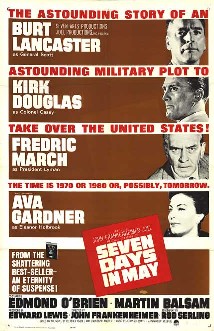
Seven Days in May (1964)

Genre: Military Conspiracy thriller

Platform: You Tube

Time: 1 hour 55 minutes

Director: John Frankenheimer

Cast: Burt Lancaster (Gen. James Mattoon Scott). Kirk Douglas (Col. Martin ‘Jiggs’ Casey). Fredric March (President Jordan Lyman). Ava Gardner (Eleanor Holbrook).

Plot:    Its 1970 and the President has signed a disarmament treaty with the Soviet Union, leading to his ratings plummeting and the hawks calling for his resignation…

Gen. Scott, the JCS is vocally and publicly critical of the President’s policies and is soon plotting away with a group of civil and military conspirators to take over the Government till his aide Col. Casey finds out about the program. Casey is aided by his former lover and Scott’s mistress Eleanor and a dipsomaniac ex-Senator who wants to find out more about the ’exercise’.

The film surely must have set the cat among the pigeons , since it came out in the aftermath of the Kennedy assassination and the then recent Cuban Missile Crisis which almost started WW3. (American Air Force General Curtis LeMay repeatedly asked permission from President Kennedy to bomb Cuba with atomic weapons). The increasing involvement in Vietnam also found an echo with the ordinary people about a rampant and unchecked military doing only what it wants to keep the machine running. The black and white photography lends itself to the gloomy conspiratorial atmosphere where one good man Casey unravels everything about the conspiracy.

Burt Lancaster and Kirk Douglas starred in seven films, the final one being the action-comedy Tough Guys (1986) as two ex-cons trying to go straight. This is their fifth film together and the veterans really compete in the laurels for the acting chops. Frederic March’s hand wringing performance mirrors the then real life President Johnson who increasingly found himself escalating the Vietnam War , at the behest of his military advisers, most of whom still believe today, that they would have ‘won’, if not for silly ‘rules of engagement’. The then “state of art technology” may look like kludge/inelegant but was true for its time.

This is a tense superb thriller and mirrors the times and fears perfectly, pointing to Frankenheimer’s expertise in superb thrillers (The Manchurian Candidate had just been released in 1962).

The film is Free at below links:


An okay English print at Internet Archives
https://archive.org/details/7-days-in-may


Another okay You Tube English version
https://youtu.be/wq0pN1RhgcE

Good You Tube print but in Spanish (English subs can be turned on)

Script – 5 out of 5

Story – 4 out of 5

Direction – 5 out of 5

Photography – 5 out of 5

 Total – 4.8 out of 5


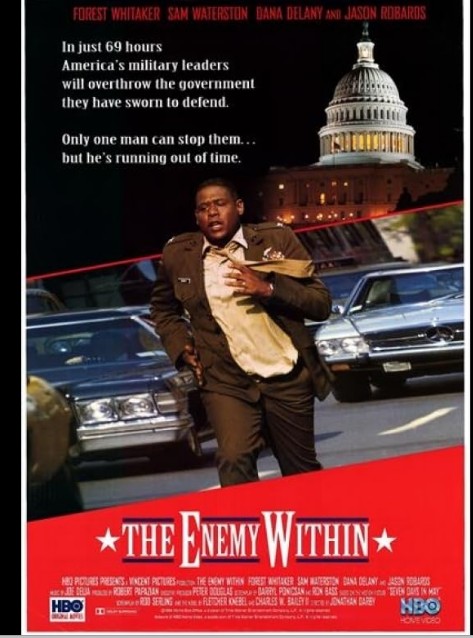
The Enemy Within (1994)

Genre: Military Conspiracy thriller

Platform: You Tube

Time: 1 hour 23 minutes

Director: Jonathan Darby

Cast: Forest Whitaker (Col. MacKenzie ‘Mac’ Casey). Jason Robards (Gen. R. Pendleton Lloyd). Sam Waterston (President William Foster).

This 1994 film is true to the spirit and letter of the novel and also has to live up to the 1964 film. In my view, this film is far better for its understated performances, especially that of Forest Whitaker as Casey who unravels the plot. Given that this is a 1994 upgrade and in colour, some digressions are a given such as Casey being a black officer, Casey’s son indulging in casual stealing from an electronics store and Casey and his wife trying to deal with it while Casey is simultaneously unraveling the plot. There are additional digressions in the shape of the Russians who help Casey – remember this was 1994 and Boris Yeltsin was seen as America’s friend while Russians viewed him as an American puppet and a plain stupid drunk politician (giving rise to Vladimir Putin and his continued rule from 1999 till date). None of these digressions take away from the core plot and in fact contribute to it.

The Russian head spy in Washington code named Jake (John Dzundza) agrees to help Casey as he doesn’t want a military government in power as it would bankrupt an already weak Russian economy. The ‘Russian agent’ who agrees to help Casey is a real surprise. As Casey, Forest Whitaker, gives one of his best performances as the man caught between his morals – between his superior officer and his promise to defend the Constitution. In keeping with the 1990s atmosphere there are some PCs , along with emails and cassettes for dictations.

Given the political shenanigans of Trump and the military at loggerheads and Trump trying to put ‘his’ people in place, the film is a better mirror of current times and holds far more relevance today.

The film is free on You Tube

Script – 5 out of 5

Story – 4 out of 5

Direction – 5 out of 5

Photography – 5 out of 5

 Total – 4.8 out of 5

One response to “Seven Days in May – Two superb versions”

  1. Robin Bhat avatar
    Robin Bhat

    Hi Rammesh,

    Please move the above review in your short-list of ‘My Best’ ! Have heard much about the book and the two films over a long time. All three now added to my ‘KVR List’.

    —
    “Burt Lancaster and Kirk Douglas starred in seven films” – this is great to know.. I was not aware..

    —
    Forest Whittaker – a superb actor… too many films to name… roles ranging from playing Idi Amin to the ‘Godfather of Harlem’, and much more.

    —-

    As to your comment on Trump and his minions, these headlines from just yesterday (June 6):

    “Residents of French village say US defense chief Hegseth not welcome for D-Day visit” and…

    “Pete Hegseth’s D-day speech on immigration condemned as ‘grotesque stupidity’ ”

    —
    One last point:
    ” President Kennedy….decided to get out of Vietnam” – probably a discussion to be had off-line.. but, as old – 60+ years – as this view is, it remains widely debated.. but it is true that ‘throughout the late 1950s (Eisenhower) and early 1960s (Kennedy and Johnson), the number of Special Forces military advisers increased steadily. Their job was to train South Vietnamese soldiers in the art of counter-insurgency…..”

    Of course, as we know, to the North Vietnamese across the paddy-fields, whether their Southern brethren or the Americans.. they were all the enemy, and to be eliminated.

    —

    Thanks… Robin

Leave a Reply

Your email address will not be published. Required fields are marked *