The Death Match – when WW2 legends meets cinema
Clickable links in red
Sometime in the mid-2000s, due to my deep interest in history and military history, I came across many hitherto unknown information that challenged the conventional (Western) military wisdom. With internet opening up in India and visiting many websites, I had many instances of new insights to old events. Many earlier accounts were now seen to be semi propaganda while others had to be revised due to new facts being revealed almost on a daily basis. One of them even questioned the supposedly ‘ superior competence’ of Western Allied generals who had access to the ULTRA secrets, the breaking of German ciphers and yet they were outfought and out maneuvered by the Germans in many engagements . I always wondered why and how the Germans fought so stubbornly, against overwhelming Allied superiority while at times the Allies appeared to be floundering in the dark.
On the Eastern Front, the earlier constant myth was that the Germans faced “human waves” of Russian soldiers and Russian generals were supposedly no good. This was the biggest lie as I understood that many Russian generals were smart and used the SAME GERMAN TACTICS against the Germans – use massive force in rapid pincer movements and crush the centre of the pincer, as happened at Stalingrad (and which accounted for the early lightning German victories from June to December 1941).
Yet another “Eastern Front story” was about a supposed ‘death match’ between Nazis and their captives. Depending on who was talking, the captives were hard core dedicated Soviet Communists, Ukrainian Nationalists, Jewish prisoners and everything else in between. The common element in all these stories was:
- The well fed, well nourished Nazis would play against a team composed of poorly fed and nourished players from the conquered territory/ country – hereafter referred to as the ‘slave team’.
- The slave team would be given their freedom if they lost to the Nazis; if they won, they were shot.
- The match was essentially an effort by the Nazis to show off their racial superiority over the “Untermenschen” – the supposed (Eastern) sub humans.
- Depending on who was talking, the slave team, ranging from Soviets, Ukrainians, Jews and everything in between, won decisively against the enraged Nazis, who shot them all dead to hide their humiliation at the hands of the supposed ‘sub humans’.
Thankfully Wikipedia has an excellent page that demolishes all the myths, with multiple citations and references.
Short version – most of the deaths were myths and the Nazis didn’t shoot any of the players. Since the matches happened in Kiev between a regular Ukrainian team and the Nazis, post war Soviet propaganda played it up to put a pro Soviet spin on the events. Some players were prosecuted as Nazi collaborators AFTER the war by the Soviets , and hence the Ukrainian version that they were all shot dead. Some survived the war and one of them even emigrated to Canada. Four ‘slave’ players were killed during WW2 for other reasons and that too long after the so called ‘death match’. Any which way you look at it , the Nazis were and are the super villains (and they will continue to be so).
As with most such stories, the enduring wisdom seems to conform to that old newspaper saying; “when the legend is larger than the truth; print the legend”. Thus, there are multiple stories and films of “slaves beat the masters’ versions, all of which are cited in the Wikipedia page. I will talk about the two films that I have seen and my conclusions on the same
Escape to Victory (1981) – Dull
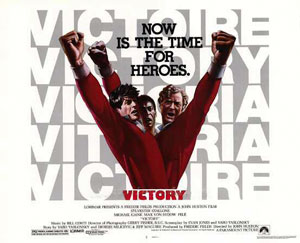
Genre: WW2 escape film + sports film
Platform: Amazon Prime US (UNAVAILABLE in India)
Time: 1 Hour 50 minutes
Director: John Huston
Cast: Michael Caine (Captain John Colby). Sylvester Stallone (Robert Hatch). Pelé (Corporal Luis Fernandez). Max von Sydow (Major Karl von Steiner).
Plot: British Captain Colby wants to escape from a POW camp along with his fellow prisoners as part of an overall plan. Canadian Robert Hatch wants to go it alone. Camp commandant Steiner has a brilliant idea of a match between the POWs and the Germans to boost the morale. Colby insists on having to pick his men from various camps and also increase their rations. Hatch escapes from the camp and meets the Resistance leaders in Paris who ask him to be deliberately captured by the Nazis so that they can plan a mass escape of all POWs and the players ….
I remember that the film was promoted internationally as one where many top football players from various countries acted as POWs and that was supposedly the main attraction. Pele, a black Brazilian, was explained as being from the West Indies, which was under British rule. The story, as with all such ‘sports’ movies, was predictable in that you know very well that the ‘home team’ would win.
I also remember that Time magazine (or was that Newsweek) had commented on the film thus (from my memory): We don’t know what is more painful to watch. Caine trying to play football or Pele trying to act. I suppose that sums up the story perfectly. Here’s a small You Tube clip which is both silly and funny at the same – Pele explaining to Michael Caine how to beat the Germans
Curiously, it was filmed in then Communist Hungary. This was because it was supposedly based on the 1962 Hungarian film Két félidő a pokolban (Two half-times in Hell), which is a Hungarian version / reworking of the legend of the Death Match, but with Hungarian POWs instead of Ukrainian players.
Unfortunately, the film is unavailable on any Indian channels and is on Amazon Prime US.
Script – 3 out of 5
Story – 3 out of 5
Direction – 4 out of 5
Photography – 3 out of 5
Total – 3.3 out of 5
The Match (2021) – Engaging
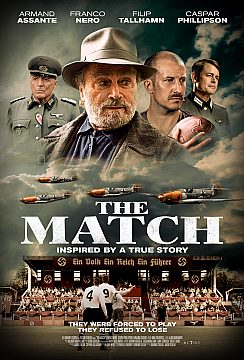
Genre: WW2 escape film + sports film
Platform: Amazon Prime India – rent
Time: 1 Hour 50 minutes
Director: Dominik and Jakov Sedlar
Cast: Franco Nero (old Branko). Viktor Kulhanek (young Branko). Andrej Dojkić (Laszlo Horvath). Caspar Phillipson (Colonel Franz).
Plot: In the current, an old Branko watches his grandson play football and lose to the opposing team. Branko takes his dejected grandson to a park and tells him that only as a team can they win football and narrates his life and death experience as a young boy during WW2. With Hungary occupied by Nazi Germany in March 1944, sizeable German troops are present in Hungary. The Hungarians don’t have much choice in what they say or do. Colonel Franz has an idea of a football match between his POWs and a Nazi team, on April 20, 1944 – Adolf Hitler’s Birthday, since he has spotted Laszlo Horvath, a famous football player, in his POW camp. Laszlo negotiates with the Colonel for better food and treatment, afternoons off for practice and so on. A young Branko who was being mistreated by another German officer is rescued by Laszlo and brought under his care and even made part of the team. The death match begins and at half time with the Hungarians leading 1-0 against the Nazis, Franz gives an ultimatum,. Lose the match and live. Win and you die. …
This is yet another variation of the same 1962 Hungarian film. The film was made in English, in Croatia and with a mix of Croat, Hollywood and actors from other countries. This is a far better film than Escape to Victory, and is engaging, once Laszlo starts training the team. Since there are less ‘stars’ to cope with, the characters are given more importance.
The only grating thing is the constant cutting between the present / old Branko and the past with young Branko watching the events unfold in front of his eyes. Laszlo’s final order to “hide and live no matter what happens in the second half of the match” is how only Branko survives and narrates his story to his grandson.
The production design is also good and though limited to the camp, the tattered dresses of the POWs contrast the fresh ones of their Hungarian oppressors and their Nazi master. The final shots of the ‘Death Match’ has some limited CGI which is not all that great. The Match itself is a foregone conclusion with the story sticking to the legend. As I said earl;ier, the Nazis will always make great supervillains. Here, it makes a very engaging film. Anyway – didn’t the film declare that it was “Based on true events” in the beginning? 😊
Script – 4 out of 5
Story – 4 out of 5
Direction – 4 out of 5
Photography – 4 out of 5
Total – 4 out of 5