Archive for month: November, 2026

Black Doves Season 2 (2026) – Sum of parts = meh!
3–5 minutes

Genre: Spy + Action

Platform: Netflix

Time: 6 x 48 minutes average

Director: Julian Farino. Kieron Hawkes

Cast: Keira Knightley (Helen Webb). Ben Whishaw (Sam Young). Sarah Lancashire (Elizabeth Reed). Andrew Buchan (Prime Minister Wallace Webb, Helen’s husband). Ambika Mod (Laila).

Plot:  Helen Webb’s husband Wallace is a shoo in for the British PM’s post. Her handler Reed is clear that the long-term strategy of the Black Doves has finally succeeded and asks Helen to be fully prepared to share the PM’s secrets. And then Reed vanishes. Helen’s assassin friend Sam is caught by the police after an assassination. In the police station, he is visited by a mysterious man named Patrick who promises him freedom – in exchange for four targeted killings.  After Reed’s disappearance, a Mr. Conteh asks Helen to continue with her task. Into this mix enters a Russian former KGB officer turned oligarch who has his own agenda. ….

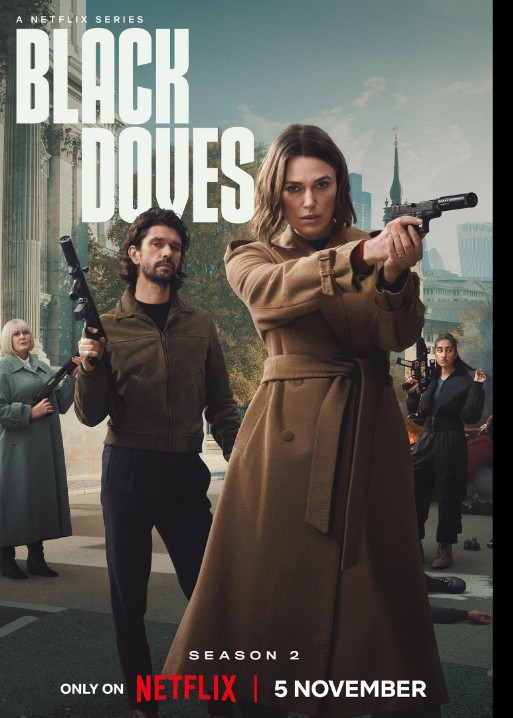
I was absolutely riveted for the first three episodes. Then after E 4,5,6  I felt cheated. Not that its not good or even crap. Many of the scenes are written well and some are even great. But the sum total of all these parts seems a very disjointed effort. There is more emphasis on gunplay and blood spattering violence. The poster of the series is the clear giveaway – everyone is toting a gun . That makes it clear what will follow in the name of spying – shootouts, shootouts and more shootouts.

The Tarantino style over the top violence and (supposedly) witty dialogues are now found wanting . This is just bigger, better and trying to out-Bond, the Bond and MI movies with the level of high speed chases, large explosions, enough ammo expended to make WW2 look like a summer holiday – in short, this is a serious case of style over content. The wafer thin plot ? Ah – lets come to that. Now Helen is the British PM’s wife and therein hangs a tale. Before reading any further if you want to check out what was my take on Season 1 , check out the link https://rammesh.co.in/2024/12/08/878/.

The tropes are already well known for those who watched Season 1, but there are many illogical things that defy explanation. Mainly, the PM’s wife can walk in and out of 10 Downing without a Personal security officer and / or no questions asked, no one tracking her movements and no one any wiser. She carries out hit jobs and returns and no one is any wiser. Sam, the assassin with a conscience, is still his same. The White lesbian pair of assassins are back and now joined by another South Asian assassin Laila Joshi (!!) whose approach to spying is very American – shoot everything that moves. The overall violence level doesn’t affect Helen and she seems to be actually enjoying it. And why is all this onscreen mayhem happening? Because Reed was involved in something very nasty, in the bad old days of the Cold War in 1988, in East Berlin – one year before the fall of the Wall.

The overall emphasis seems to be less on the cheeky lines, which is left to the lesbian assassins, while the hyper violence is left to Joshi, Helen, Sam and assorted men in black, shooting it out with each other. All the anonymous opponents of the quartet die like flies while they remain unscratched. There is less of spying and more of violent gunplay of the automatic weapons, grenade explosions type, combined with the traditional high speed car chases. There are enough holes in the story that make you think “where on earth is the logic of this? where is this going?” and so on.

The way the last episode ends, it’s clear that they have left room for a possible S3 – that is if Sam doesn’t end up becoming a monk in the very monastery where he carried out a hit, and Helen doesn’t end up becoming a schizophrenic because of her role as the PM’s wife and a Black Dove, and confessing her duel roles to her psychiatrist cum marriage counsellor.

The overall feeling is like reading a comic book; if that is the intention then it has succeeded admirably.

Summary : Keep your brains outside if you want to enjoy this. I couldn’t!

Script – 2 out of 5

Story – 2 out of 5

Direction – 3 out of 5

Photography – 3 out of 5


Total – 2.5 out of 5
No comments on Black Doves Season 2 (2026) – Sum of parts = meh!

The Death Match – when WW2 legends meets cinema

6–9 minutes

Clickable links in red

Sometime in the mid-2000s, due to my deep interest in history and military history, I came across many hitherto unknown information that challenged the conventional (Western) military wisdom. With internet opening up in India and visiting many websites, I had many instances of new insights to old events. Many earlier accounts were now seen to be semi propaganda while others had to be revised due to new facts being revealed almost on a daily basis. One of them even questioned the supposedly ‘ superior competence’ of Western Allied generals who had access to the ULTRA secrets, the breaking of German ciphers and yet they were outfought and out maneuvered by the Germans in many engagements . I always wondered why and how the Germans fought so stubbornly, against overwhelming Allied superiority while at times the Allies appeared to be floundering in the dark.

On the Eastern Front, the earlier constant myth was that the Germans faced “human waves” of Russian soldiers and Russian generals were supposedly no good. This was the biggest lie as I understood that many Russian generals were smart and used the SAME GERMAN TACTICS against the Germans – use massive force in rapid pincer movements and crush the centre of the pincer, as happened at Stalingrad (and which accounted for the early lightning German victories from June to December 1941).

Yet another “Eastern Front story” was about a supposed ‘death match’ between Nazis and their captives. Depending on who was talking, the captives were hard core dedicated Soviet Communists, Ukrainian Nationalists, Jewish prisoners and everything else in between. The common element in all these stories was:

  1. The well fed, well nourished Nazis would play against a team composed of poorly fed and nourished players from the conquered territory/ country – hereafter referred to as the ‘slave team’.
  2. The slave team would be given their freedom if they lost to the Nazis; if they won, they were shot.
  3. The match was essentially an effort by the Nazis to show off their racial superiority over the “Untermenschen” – the supposed (Eastern) sub humans.
  4. Depending on who was talking, the slave team, ranging from Soviets, Ukrainians, Jews and everything in between, won decisively against the enraged Nazis, who shot them all dead to hide their humiliation at the hands of the supposed ‘sub humans’.

Thankfully Wikipedia has an excellent page that demolishes all the myths, with multiple citations and references.

Short version – most of the deaths were myths and the Nazis didn’t shoot any of the players. Since the matches happened in Kiev between a regular Ukrainian team and the Nazis, post war Soviet propaganda played it up to put a pro Soviet spin on the events. Some players were prosecuted as Nazi collaborators AFTER the war by the Soviets , and hence the Ukrainian version that they were all shot dead. Some survived the war and one of them even emigrated to Canada. Four ‘slave’ players were killed during WW2 for other reasons and that too long after the so called ‘death match’. Any which way you look at it , the Nazis were and are the super villains (and they will continue to be so).

As with most such stories, the enduring wisdom seems to conform to that old newspaper saying; “when the legend is larger than the truth; print the legend”. Thus, there are multiple stories and films of “slaves beat the masters’ versions, all of which are cited in the Wikipedia page.  I will talk about the two films that I have seen and my conclusions on the same


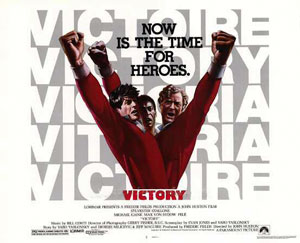
Escape to Victory (1981) – Dull

Genre: WW2 escape film + sports film

Platform: Amazon Prime US (UNAVAILABLE in India)

Time: 1 Hour 50 minutes

Director: John Huston

Cast:  Michael Caine (Captain John Colby). Sylvester Stallone (Robert Hatch). Pelé (Corporal Luis Fernandez). Max von Sydow (Major Karl von Steiner).

 Plot:  British Captain Colby wants to escape from a POW camp along with his fellow prisoners as part of an overall plan. Canadian Robert Hatch wants to go it alone. Camp commandant Steiner has a brilliant idea of a match between the POWs and the Germans to boost the morale. Colby insists on having to pick his men from various camps and also increase their rations. Hatch escapes from the camp and meets the Resistance leaders in Paris who ask him to be deliberately captured by the Nazis so that they can plan a mass escape of all POWs and the players ….


I remember that the film was promoted internationally as one where many top football players from various countries acted as POWs and that was supposedly the main attraction. Pele, a black Brazilian, was explained as being from the West Indies, which was under British rule. The story, as with all such ‘sports’ movies, was predictable in that you know very well that the ‘home team’ would win.

I also remember that Time magazine (or was that Newsweek) had commented on the film thus (from my memory): We don’t know what is more painful to watch. Caine trying to play football or Pele trying to act. I suppose that sums up the story perfectly. Here’s a small You Tube clip which is both silly and funny at the same – Pele explaining to Michael Caine how to beat the Germans

Curiously, it was filmed in then Communist Hungary. This was because it was supposedly based on the 1962 Hungarian film Két félidő a pokolban (Two half-times in Hell), which is a Hungarian version / reworking of the legend of the Death Match, but with Hungarian POWs instead of Ukrainian players.

Unfortunately, the film is unavailable on any Indian channels and is on Amazon Prime US.

Script – 3 out of 5

Story – 3 out of 5

Direction – 4 out of 5

Photography – 3 out of 5

Total – 3.3 out of 5

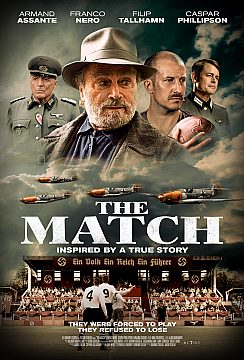
The Match (2021) – Engaging

Genre: WW2 escape film + sports film

Platform: Amazon Prime India – rent

Time: 1 Hour 50 minutes

Director: Dominik and Jakov Sedlar

Cast:    Franco Nero (old Branko). Viktor Kulhanek (young Branko). Andrej Dojkić (Laszlo Horvath). Caspar Phillipson (Colonel Franz).

Plot:  In the current, an old Branko watches his grandson play football and lose to the opposing team. Branko takes his dejected grandson to a park and tells him that only as a team can they win football and narrates his life and death experience as a young boy during WW2. With Hungary occupied by Nazi Germany in March 1944, sizeable German troops are present in Hungary. The Hungarians don’t have much choice in what they say or do. Colonel Franz has an idea of a football match between his POWs and a Nazi team, on April 20, 1944 – Adolf Hitler’s Birthday, since he has spotted Laszlo Horvath, a famous football player, in his POW camp. Laszlo negotiates with the Colonel for better food and treatment, afternoons off for practice and so on. A young Branko who was being mistreated by another German officer is rescued by Laszlo and brought under his care and even made part of the team. The death match begins and at half time with the Hungarians leading 1-0 against the Nazis, Franz gives an ultimatum,. Lose the match and live. Win and you die. …

This is yet another variation of the same 1962 Hungarian film. The film was made in English, in Croatia and with a mix of Croat, Hollywood and actors from other countries.  This is a far better film than Escape to Victory, and is engaging, once Laszlo starts training the team. Since there are less ‘stars’ to cope with, the characters are given more importance.

The only grating thing is the constant cutting between the present / old Branko and the past with young Branko watching the events unfold in front of his eyes. Laszlo’s final order to “hide and live no matter what happens in the second half of the match” is how only Branko survives and narrates his story to his grandson.

The production design is also good and though limited to the camp, the tattered dresses of the POWs contrast the fresh ones of their Hungarian oppressors and their Nazi master. The final shots of the ‘Death Match’ has some limited CGI which is not all that great. The Match itself is a foregone conclusion with the story sticking to the legend. As I said earl;ier, the Nazis will always make great supervillains. Here, it makes a very engaging film. Anyway – didn’t the film declare that it was “Based on true events” in the beginning? 😊

Script – 4 out of 5

Story – 4 out of 5

Direction – 4 out of 5

Photography – 4 out of 5

Total – 4 out of 5

2 comments on The Death Match – when WW2 legends meets cinema

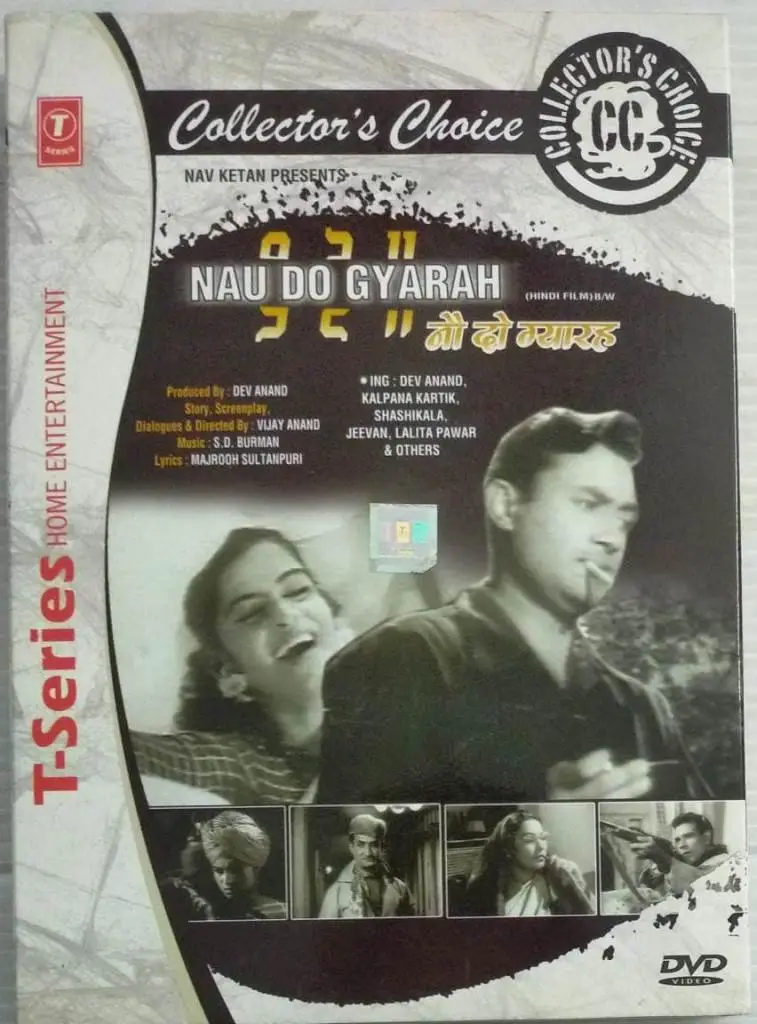
Nau Do Gyarah (1957) – Breezy Classic Road Movie

5–8 minutes

Genre: Road Movie / Road comedy

Platform: You Tube Free

Time: 2 hours 35 minutes  

Story, Screenplay, Director: Vijay Anand

Cast:   Dev Anand (Madan). Raksha (Kalpana Karthik). Jeevan (Surjit). Madan Puri (Radheshyam “Radhey”). Shashikala (Neeta). Krishan Dhawan (Kuldeep). Lalita Pawar (Kuldeep’s mother).

Plot: Totally broke and thrown out of his rented home, Madan learns that he is heir to a fortune of 11 lakhs left by his late uncle in Mahabaleshwar. En route, he encounters a runaway woman Raksha, who initially dresses up as a male Sardar Nihal Singh. Soon the cat is out of the bag and a romance develops. Madan reaches Bombay and informs his friend Radhey about both the fortune and his new found woman in his life. Radhey promises to help. Madan and Raksha pretend to be a married couple to stay at Mahabaleshwar and to find out about the uncle’s mysterious death…

Twenty-three-year-old Vijay Anand wrote the story, screenplay and directed the film. Modern viewers may scream about ‘nepo brothers’ and similar stuff but in this case Vijay Anand’s deft and firm touch in all departments was clearly visible. Goldie as Vijay Anand was popularly known, really had a golden touch when it came to the box office and this was his first collaboration with big brother and producer, Dev Anand. The pair reached its peak with the stylish 1967 thriller Jewel Thief but that’s for another day and time.

Nau Do Gyarah can be easily said to be Hindi / Indian cinema’s first ever ‘road movie’ and a very loose adaptation of It happened one night (1934), the only commonality being that the lead female character is a runaway heiress. It happened one night was remade at least three times in Hindi Cinema as Solva Saal, Chori Chori and Dil hai ke maanta nahi, the last being the most ‘true’ to the original, right down to scenes being almost copy-pasted.

As we all know, a road movie is where two characters, usually men of opposite temperaments, go or are forced to share a car / bus on a journey. If it’s a man and a woman, typically romance follows. Usually, the lead male and female actor essay the lead characters, making it easy for the audience to identify with the lead pair as they embark on a journey. If it is two men on a journey, either they will bond as friends or in some extreme cases, end up as antagonists, leading to violent climactic scenes.

A cursory look at the outdoor makes it clear that some scenes were definitely shot outdoors in Delhi, Bombay and Mahabaleshwar. This is one of the few films where Dev Anand, in keeping with the character, doesn’t keep changing his clothes from scene to scene. His acting has also a light comic, almost self-deprecatory touch as befitting a character who is broke and penniless, yet defiant to ask for help as in the scene where ‘Sardar Nihal Singh” offers to pay for the petrol for his onward journey to Bombay.

The romantic development naturally follows after the initial fights and the usual haughty acts of a rich haughty woman who has escaped her home from a marriage against her will since the groom Surjit was demanding more money, moments before the marriage. By the long arm of coincidence, Jasjit turns up at Mahabaleshwar with a girlfriend Neeta, who is also enticing Kuldeep with her feminine charm.

A Navketan film without music would be an anomaly. Navketan’s “House Composer” S.D.Burman gives an overall lightweight touch to the proceedings as befitting a romantic comedy cum road movie. Most of the songs have become classics barring the ‘club’ numbers and the unique climatic song with an integrated fight sequence. Since its one of my favorite Dev Anand films and favorite SD Burman albums, lets look at the songs and the order in which they appear in the film, for which SD Burman’s favorite lyricist Majrooh Sultanpuri does immense justice as per the song situation. (Both Burman and Majrooh shared the same date of birth, October 1)

  1. Hum hai raahi pyar ke humse kuch na boliye – a broke Madan leaves Delhi on his onward journey to Bombay. Kishore Kumar gives the song a lightweight touch and the whistle interludes remain unique. Immediately after this song, Madan spies the stowaway Raksha in his truck. The song was reused in Dil hai ke maanta nahi when the lead couple dance slowly to the song in a remote stop, while the song plays on a radio.
  2. Kali ke roop me chali ho dhoop me – the haughty Raksha , now in a female dress, is on foot , talking about how she can walk alone on the hot road while Madan sitting comfortable in the driver’s shaded cabin, teases her. Mohammed Rafi’s special velvet ‘Dev Anand’ voice complements Asha Bhosle singing for the heroine Kalpana Karthik.
  3. Aankhon me kya jee rupahla baadal – This Kishore- Asha duet was almost banned as it was felt by the censors that it was full of sexual innuendo! Especially the line “Aachal me kya jee, ajab see hulchul”. So much for censors! The light romantic duet shows Madan and Raksha’s growing affection for each other
  4. Kya ho jo din rangeela ho – This Geeta Dutt – Asha duet fulfils one standard trope of those years, for a ‘club dance. Geeta Dutt sings for Shashikala while Asha sings for Helen who appears only in this song.
  5. Oh aaja panchi akela hai – Madan and Raksha are supposedly husband and wife but they live in separate rooms, he in the bathroom and she in the bedroom. Hence his playful suggestion and her retort to go to sleep, yet another breezy, playful Rafi-Asha romantic duets.
  6. Dhalti jaaye chundariya – Asha sings for Raksha who is expressing her new found love.
  7. Jaane jigar haay haaye – Asha sings for Neeta who is trying to seduce Madan. At the song’s end , a jealous Raksha throws a stone at Madan who in the next scene explains to an amused Raksha that a crow bit him on the head.
  8. See le zubaan – this is probably one of the most unique song picturisation ever in the history of Indian films. While Kuldeep and Surjit are fighting , Neeta is warning Kudeep’s mother not to say anything in front of Madan. The fight goes on and so does the song ! Unique and in no way distracting. Goldie had mastered the art of integrating the song and the scene.

4, 6,7,8 were not numbers that had lots of airplay while the other songs four songs were super hits and could be heard in almost all ‘retro’ radio programs on AIR and Radio Ceylon.

Its also worth mentioning that the choreography was by Zohra Sehgal. The same Zohra Sehgal whom most late 20th and 21st century audiences know as the loveable and or cranky granny.

Overall, the songs, the story and the screenplay are so deftly woven that we fail to appreciate the superb craftsman that was Goldie who integrated everything into a film that can be classified as India’s first ever road movie. Dev Anand and his wife Kalpana Kartik, in her last onscreen appearance, also show some lovely onscreen chemistry, befitting the film’s overall lightweight breezy structure. For its time, it may have been a risk for such a unique theme, but it proved to be a box office hit

The film is free on You Tube

https://youtu.be/sHqlMGEkU40?t=1


Script – 5 out of 5

Story – 5 out of 5

Music – 4 out of 5

Direction – 5 out of 5

Photography – 4 out of 5

Total – 4.6 out of 5

4 comments on Nau Do Gyarah (1957) – Breezy Classic Road Movie