
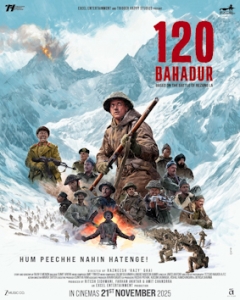
 Genre: War movie (True Story)
Platform: Theatrical release
Time: 2 Hours 17 minutes
Director: Razneesh Ghai
Cast: Farhan Akhtar (Major Shaitan Singh Bhati). Sparsh Walia (radio operator Ramchander Yadav).
Plot: In November 1962, a young man, running in a blazing snowstorm collapses. He wakes up in a military hospital and is soon questioned by the senior most officer. Ramchander was the radio operator of Charlie Company of 13 Kumaon Regiment, tasked with holding a narrow pass, known as Rezang La. He narrates the story of how he was posted to the forward location of Charlie Company, how Major Shaitan Singh had anticipated the Chinese movements towards Chushul airstrip through the narrow Rezang La Pass and how the 120 men of Charlie Company fought, to the last man and the last bullet…
It is always a challenge to make a film whose historical outcome is already well known. Major Shaitan Singh was awarded India’s highest military medal the Param Vir Chakra, posthumously. But who were the men who did this extraordinary job ? What was their mental state? What were they going through ? This is where the film goes for the Haqeeqat / Border template as below:
- In the present the soldiers , at the forward post, are about to confront the enemy.
- They think of their lives in their homes and remember their loved ones.
- The enemy is about to attack.
- The commander is given a choice to stay or withdraw; he decides to stay and fight the enemy.
- The battle ensues.
(How many films can you, the reader, think about with a similar template?)
In Haqeeqat’s final battle there were only 3 Indians against hordes of Chinese while in Border it was a company (around 120 men) against a Pakistani Brigade (around 1500 – 2000 men), with tank support. This formula has been done in various permutations and combinations, including banter between the married and unmarried men. These are all done and dusted and it is no different in this film.
Yet , it is engaging , as we want to know HOW everything happened.
Needless to say the ‘romance’ between the Major and his wife leads to flashback scenes complete with dances, holi scenes and the landscape around Mehrangarh fort in Jodhpur, providing the visual spectacle for their romance. Naturally , these scenes drag (similar to Dharmendra romancing Priya Rajvansh in Haqeeqat and Akshaye Khanna romancing Pooja Bhatt in Border). Then there has to be a “comrades together” song and finally a sad song while the camera pans over the dead and the memorials. Often people ask me why India can’t make its own Saving Private Ryan style war movie. That’s because of our tendency to add the above style masala elements, that drag the pace of the film. (One ex Fauji who was consulting on a movie , told me the same – the industry WANTS a romantic song and female characters – else it wont pull the female audience. So goes their argument)
Before and during the battle scenes, the war cries of the regiment is repeatedly shouted by the soldiers. In the middle of the battle too, Shaitan Singh keeps screaming the war cry. (Border had Sunny Deol screaming the war cry of the Punjab Regiment). This film has a similar opening scene as in Border where Sunny Deol tempts the Pakistani border post . Here Shaitan Singh goes single handed against a Chinese sniper and his spotter ; since the wind is against then, the Chinese bullets are off target Naturally, the Indian sniper gets first shot first kill since the wind is with him and towards the Chinese.
Thus all “Indian war movie template points” are ticked. Our film makers consciously or unconsciously do not want to dispense with this template.
So . What’s left of the movie to watch ?
Plenty. The initial scenes of Shaitan Singh recceing the terrain and suddenly watching the gathering Chinese forces, send a chill down one’s spine.
The actual attack by the Chinese is well executed on screen. It is well known to everyone now that the Indian side only had bolt action 0.303 rifles from WW2 vintage while the Chinese had the fully automatic AK47 and the semi-automatic SKS , both of Russian origin. That’s about 5 Indian bullets in 10 seconds versus 30 bullets by an AK47 in 10 seconds. The Chinese also had heavy weapons support with mortars, MMGs and heavy artillery. The Indian side had a mortar section. All these are shown accurately. Unfortunately, neither the Indian nor the Chinese small arms are shown ejecting empty cartridges.
The battle scenes are easily the best directed and its scale, with progressive fall-back positions, the Chinese flanking the positions and then overwhelming them – all these are shown accurately. When Shaitan Singh issues his final order to Ramchander Yadav, to survive, it does bring a lump to one’s throat. For those interested in the real history, you can refer to this excellent website on Indian Armed Forces, Bharat-rakshak which details the story .
Link : https://www.bharat-rakshak.com/army/history/1962war/rezang-la/
The controversy about the Ahir community not being credited and mentioned is ridiculous. They are mentioned time and again in the film .
This is a decent watchable mixture of history and Bollywood masala, though I wish they had toned down the masala, which would have reduced the length to about one hour and fifty minutes.
Real History – 4 out of 5
Equipment / Kit – 4 out of 5
Locations/substitutes – 5 out of 5
Masala elements – 2 out of 5
Script – 4 out of 5
Direction – 4 out of 5
Total – 3.9 out of 5
Good review. Makes me feel tike want to see the film. Thanks.
Thanks..will watch it now.
Thanks for the beautiful review .. Definitely gets added to the list of movies to watch this holiday season
Rammesh,
Thanks for your fine review. I’ll be able to better appreciate the film, which I plan to see tomorrow.
—
Regards… Robin
PS.. unrelated to the film.. but your comment: “Akshaye Khanna romancing Pooja Bhatt in Border”…. reminded me of one of Anu Malik’s exquisite compositions.. ‘humein jabse mohabbat’… …as I recall, it was removed from the original, theatrical release but thankfully later restored in DVDs.
While writing this, also reminded of the fabulous RKR song from the same film..though on the screen it was amusing.. soldier croons at bedtime.. goes to war in the morning :)
Hi Rammesh,
Watched the film.. again read your review… have saved your fine link to ‘bharat.rakshak.com’ (to be read later this weekend).. and also read the chapter on the India-China War of 1962 in the fine book, “India’s Wars, 1947-1971, a Military History” by Air Vice Marshal/IAF, Arjun Subramaniam.
Two quotes from his detailed history, which may be relevant:
“There is little point in attempting a profound facetiousness and writing off China as a riddle wrapped in an enigma. Failure of intelligence, no less than failure of nerve can manifest itself in seeing Han expansionism” – General K.S. Thimayya, after the 1962 war.
And, on the other side, in 2015, in The Economic Times:
“To ensure that the bravery of the Indian Army is not undermined, the RSS wants those battles to be highlighted where the soldiers showed exemplary courage in the face of extreme odds. The India-China war need not be just a shameful episode for India. We can tell the children about one of the most embarrasing episodes of our history by highlighting the gallantry of our troops. The war could be used to instill pride and also serve as a crucial lesson in diplomacy.”
—
My own input:
The film’s end credits:
Yes, photos and names of Major Shaitan Singh (Param Vir Chakra) and eight others (Vir Chakra) are highlighted. Well done, film director.
But what about the other 111! Their names are quickly rolled through, just above the names of the ‘Pagdi Drapers'(!) …. about a 15-second roll.
Surely, the filmmakers could have dedicated 12 names x 10 screens at 20 seconds each, to get the audience to know at least their names of these ‘Bahadur’ ? Their photos too should have been unearthed. This would surely be a powerful gesture of remembrance and conferred dignity.
At least more than the ‘wind is with me/wind is against you’ nonsense. Only Clint Eastwood sitting on a horse with a squint in his eyes and a gun out of his holster can say that.
Thanks!
Robin
Robin
Well said. Some points to enhance your discussion (it can actually be a never ending one)
1. Arjun Subramaniam in his first book “India’s Wars” says clearly that the strategic establishment’s mindset is more concerned with studying victories than defeats. I guess that says it all and why there are no sightful books on the Sri Lankan imbroglio (actually there is one that is not well known and I have it .India’s SriLankan misadventure minces no words on the overall shambolic jugaad type nature of operations).
2. As for mentioning the names of the other 111, I agree . A “roll of honour”, even if fleeting, could have been done.
3. IMO all the 120 deserved awards – big or small
KVR