
G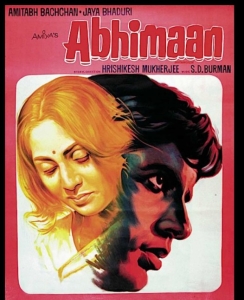 enre: Musical Drama
Platform: Theatre Special / You Tube
Time : 2 hours 2 minutes (You Tube)
Writer Director: Hrishikesh Mukherjee
Cast: Amitabh Bachchan (Subir). Jaya Bhaduri (Uma). Bindu (Chitra). Asrani (Chandu). AK Hangal (Sadanand – Uma’s Father). Durga Khote (Durga Mausi). David (Brijeshwar Rai).
Plot: Two singers get married and soon the husband becomes jealous of his wife’s increasing popularity..
Modern films that claim to be “based on true stories” , usually have a long disclosure about “Based on true stories and dramatized for the screen with fictional events; doesn’t purport to be a historical records; no disrespect is intended to the characters or (especially) the Armed Forces” and so on. Such a disclosure would have certainly fit Abhimaan’s story perfectly, since it is based on the true story of two leading classical instrumentalists who fell out , resulting in the woman, the better talented of the duo, promising that she will never perform in public – a promise she kept till her death.
 When I was researching my book on Hrishida’s films , Human Cinema (available on Amazon in kindle and paperback at this link) https://www.amazon.in/Human-Cinema-Films-Hrishikesh-Mukherjee/dp/1643249541 , I had tried my best to find out who were the famous couple on whom the film’s story was based or whether any such real story existed. In the book, I had concluded that the most likely source of such a story is the real life musical and personal estrangement of Pandit Ravi Shankar and his wife Annapurna Devi. These days, there are multiple confirmations of this story – namely that it was a fictionalised story of the real life troubles of the talented duo. There is also a biography of Annapurna Devi which also confirms the split between the duo. After her death, Annapurna Devi’s disciples have become totally vocal about how Pandit Ravi Shankar consistently tried to dominate her and finally she swore never to perform in public , a promise she kept till her last breath. Check out this link about the disciples talking now ; surely if this had been aired when both were alive, law suits would have flown left right and centre https://youtu.be/6fcdMg-NrcA
Further there is confirmation that Hrishida who knew Annapurna Devi well met her personally to discuss the story . At her insistence , the film had a happy ending, with the couple walking away to thunderous applause from the audience’. Check out this video where the exchange between Annapurna Devi and Hrishida is discussed briefly
https://youtu.be/CPlaJxLJDwE?t=862
As for the film, it has all the typical Hrishida quirks and the “usual suspects” – actors whom he (was probably fond of and ) repeatedly used in many of his film. It is a given that sooner or later most actors become typecast in their roles because ‘it was a hit”. As always , Hrishida broke this typecasting; except for Durga Khote’s benevolent elder Durga Mausi and AK Hangal’s benevolent father Sadanand, none of the other characters were typecast. Lets take a repeat view of the characters:
- Amitabh Bachchan – Zanjeer had just happened and he was not the “angry young man” though his jealousy came out as anger at Uma. Later, when he knows about Uma’s tragedy and the stillborn child, his anger turns to remorse and he looks for redemption. Redemption as a theme is universal in films and more so in Hrishida’s films.
- Jaya Bhaduri – Uma is the small town girl who discovers love, moves to the city, and is perplexed at Subir’s increasing sarcasm and jealousy, even deciding that she will not sing at all.
- Asrani – Aha! No. He doesn’t do that . He is the loyal friend cum secretary Chandru, who stays by Subir’s side, through thick and thin , and even has a hand in getting the couple back together.
- Bindu – As I said in my book, we wait for “Bindu” to do something nasty but Chitra doesn’t . As soon as the song “Teri Bindiya Re” ends, she walks up with a hint of tears in her eyes, congratulates the couple and graciously says that she was no competition for Uma. Later when Subir is separated and staying with her, Chitra asks Uma “do you think I have taken him away from you?” Uma immediately stops her and says “No. Only those who love know…” The rest is unsaid . Chitra did love Subir but it is Uma who acknowledges it – and that’s why Chitra bawls at Subir to stop acting nasty and go back to HIS home.
- David – HE always played some avuncular character in all films and especially so in Hrishida’s films. Here , he is a classical singer who recognises that Uma is far more talented than Subir and her music being stifled will lead to more troubles for the couple.
The film wouldn’t have been what it was without the music. While his contemporaries had all fallen by the wayside or slowed down work or were unable to find any work in the new environment , S.D.Burman was still giving great music in the 1970s , with superb melodies which he was always known for. His usual musical assistants Basu, Manohari ,who also assisted son R.D.Burman were missing here. This time the assistants were Anil, Arun, Maruti Rao (also assistant to RD) and Meera Dev Burman. Majrooh Sultanpuri wrote one gem after another , with the songs always forwarding the story and not an interruption.
The songs – and an amusing interpretation which I have mentioned in my book – deserve a special mention.
- Meet na mila re manka – Kishore Kumar. Before the song starts, there is a variety show where mimicry artists and a dancer are on stage. This was VERY true for 1970s stage shows where the music would be interrupted by a mimicry artist and then a ‘record dance’. Dinesh Hingoo, who later became a comedian in the 1980s, and 1990s, was the most popular mimicry artist in the 1970s. As for the song , all the usual suspects of the Burman camp – Kersi Lord on accordion, Manohari Singh on saxophone – are there with expertly played interludes
- Nadiya Kinaare, heraaye aayi kangna – the first of three Lata Mangeskar gems in the film. This is when Subir sees Uma first and is surprised to know that she is the daughter of the local music teacher Sadanand whom his Mausi knows very well. This is followed by a super-fast “chat mangni pat byaah”.
- Teri Bindiya re – the first duet of the film. Mohammed Rafi and Lata Mangeshkar follow a ‘call and answer” style of singing while the arrangement is typical SD Burman with minimal instruments.
- Lutey koi manka nagar banke mera saathi – Manhar and Lata sing this duet. This is when the duo decide to sing together and David’s character says that this would be a disaster as Uma is more talented than Subir. Just before the song starts, you can see the “usual suspects” from Hrishida’s camp of assistants and technicians . Singer Nitin Mukesh, who is credited as an assistant director for the film, can be seen in a flowered pink shirt , as a “sound recordist”. Beyond him in a floral shirt with a white background, is Jaywant Pathare, Hrishida’s steady cinematographer from 1959 till about 1988.
- Ab to hai tumpe jar Khushi apni – Uma’s first solo song has Subir getting increasingly uneasy as the producers want only her and not him.
- Piya bina piya bina – Conveys Uma’s infinite pain at the turn of events and she deciding to return to her father’s place
- Tere mere milan ki ye raina – Kishore and Lata. The song is sung as a Kishore solo BEFORE the couple part and is there for about 5oseconds. This grand finale is of course the happy ending that everyone wants, including Chitra who is weeping and applauding, when the song finishes.
This is where I MUST relate the amusing anecdote which I have mentioned in the book .😊
SD Burman always had this somewhat disconcerting habit of using different singers in the same film for the same actors for different songs. His explanation was the singer should suit the song and not the other way around. So we start with Kishore through Rafi through Manhar and then finally back to Kishore. At that time I had asked a DIE HARD Kishore Kumar fan whether I could cite him and his (amusing) explanation . He said “don’t use my name but you can use my explanation”. So, as per this friend, what’s the explanation ?
Kishore is THE voice of Subir. As Subir gets stressed , his voice DETERIORATES – hence Rafi and Manhar – and FINALLY HE RECOVERS his original voice. 😊
This is a typical Hrishida film where there are no heroes, no villains. Only humans struggling with what life throws at them. (How one wishes such films were made these days ).
The crowd at this special screening was mixed with people in their 20s and 30s making up about 60-70% of the crowd. It was nice to see the songs being hummed as they were onscreen – of course I do not know whether they were being hummed by the 70% or the remaining 30% .
Remember. If you become like Subir, you might end up losing your Uma ! From that angle, Abhimaan is a cautionary tale ! The film is available free on You Tube
https://youtu.be/DOV4axpdcXo?t=6
The REEL LIFE story had a happy ending . The REAL LIFE story didnt – as seen by the You Tube links mentioned above.
Script – 5 out of 5
Story – 5 out of 5
Direction – 5 out of 5
Soundtrack – 5 out of 5
Total – 5 out of 5
One of those films I will never be tired of re-watching. Hard to say which Hrishida film, in his peak years, was his best, but this is definitely among his best few. And similarly among the top few of dada Burman too.
I have a feeling that it was not directly inspired from Pt Ravishankar and Annapurna Devi’s life story – maybe the seed of the story lied there, rest was all manufactured for the film. Ravishankar and Annapurna were estranged for many years before their real seperation – an alleged affair being one of the chief reason – and they never reconciled even till his death.
A book could be written only on Abhiman, maybe you should take that task :-)
Naresh
Check out the video links in the post where the disciples and the moderator clearly say what happened. In the second video , the moderator is alone and she talks about how Hrishida met Ma . There can be no doubt whatsoever that this is the real story.
Hi Rammesh,
Just some notes to add to the songs section of your post:
1
Lute koyi man ka nagar: (Manhar/Lata)
My understanding is that this was a scratch-recording; the final version was to be done with Mukesh;
And Mukesh, in an act of noblesse oblige’ (the second time around.. the first being in Vishwas) asked SDB to keep the Manhar version.
For once, I disagree with Dada Burman! if he had made the duet with Mukesh… I am almost 100% certain history would have been created:
Even as late as as 1973, the first film to carry a Lata duet each with Mohd. Rafi, Kishore Kumar and Mukesh!
There are many films with Lata duets with two of three three male singers; none with all three that I know of, with Abhimaan being a narrow miss.
2
Tere Mere Milan Ki Ye Raina:
As we know, it is famously inspired by Rabindranath Tagore’s “Jodi Tare Nai Chini”. I believe this is Raag Khamaj, and Bappi Lahiri went to the same fount in Jhooti – ‘chanda dekhe chanda’, again with KK/Lata.
3
Tere Mere Milan Ki Ye Raina – the short solo version, with Amitabh at the piano. As per norm, it was carelessly left out of the OST; Though, I’m sure like many others must have done – I ripped the audio and the video from the DVD for my own pleasure.
Lastly, though we praise the music director and singers all day long.. cannot forgot the beautiful lyrical pen of Majrooh Sultanpuri.
—
ABHIMAAN:
My list of ‘Five Favorite Films of Hrishikesh Mukherkee’ changes every week.. but the classic Abhimaan has a permanent place, more or less :)
—
Regards,
Robin
Hi Rammesh,
Follow-up to my earlier reply. Throwing around the raag name for ‘tere mere milan ki raina’ – Raag Khamaj – was not to ‘show-off’ my classical chops (which, as you know, are ZERO!).. but as a prompt to invite ourselves in discovering other songs in the same raag.
There are many such lists on the internet (and kudos to their authors for disseminating this).. but a small sample, as generated by Google Search consists of:
Piya Tose Naina Laage Re (Guide)
Kuch To Log Kahenge (Amar Prem)
O Sajna Barkha Bahaar Aayi (Parakh)
Aayo Kahan Se Ghanshyam (Buddha Mil Gaya)
Raina Beeti Jaaye (Amar Prem)
Pyaar Hua Chupke Se (1942: A Love Story)
Mera Man Tera Pyasa (Gambler)
Dil Hai Chhota Sa (Roja)
Main Zindagi Ka Saath Nibhata Chala Gaya (Hum Dono)
Luka Chuppi (Rang De Basanti)
—–
One of the many excellent links to this same topic: (where the author is an expert on the subject):
https://chandrakantha.com/music-and-dance/film-and-pop/film-songs-rags/khammaj/
A more casual list at Spotify:
https://open.spotify.com/playlist/1MlCiZrI6EKXbJI2S6wMqS
Thanks,
Robin