
All clickable links in red
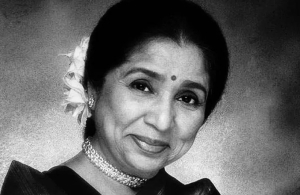
Asha Bhosle. Last of the greats of the Golden Melodies Era. Physically no more in this world. But to use a heavily cliched phrase, she and her music lives on . Forever.
Tributes continued to pour in when her passing was announced. News and print media spoke of her great output and so on. One clueless person was talking on a TV channel, by phone, about how she was the symbol of the hippie era when she sang the great song Aayiye Mehrbaan. Clearly he meant Dum Maro Dum but then who cared. Twenty seconds of fame achieved.
Print media listed many ‘great songs’ and it was as if she had sung ONLY with RD Burman and no one else. There was very little mention of her works with others. Which frankly speaking bugged me no end. Since Pancham died, it has become fashionable to talk of only her output with him and no one else.
When Asha started working with Pancham more in the 1970s and became his ‘go to’ female singer, she was like a finely polished high grade diamond that could cut through anything. (If you prefer a cricket analogy, she was ready as an all rounder). The man who forged that diamond is hardly written about in most of the tributes and this first part of my Asha tribute is about him and the magic he created with her. The man ? O.P.Nayyar .
Let me also confess frankly that I AM biased in Nayyar’s favour. In my worldview of the ‘era of yester years/ golden music era’, my order of favorite Music Directors order is simple.
No.1 is SD Burman
No. 1.5 is OP Nayyar.
No. 2 is RD Burman.
Some who know me for a long time may be surprised by this “new” order! The reason for OP moving up the ladder and Pancham becoming No.2 , is simple. Like my No.1 , he created simple melodies that an ordinary man could and did hum, leave along sing. When I looked at a list of my favorites I was surprised how much OP was above RD.
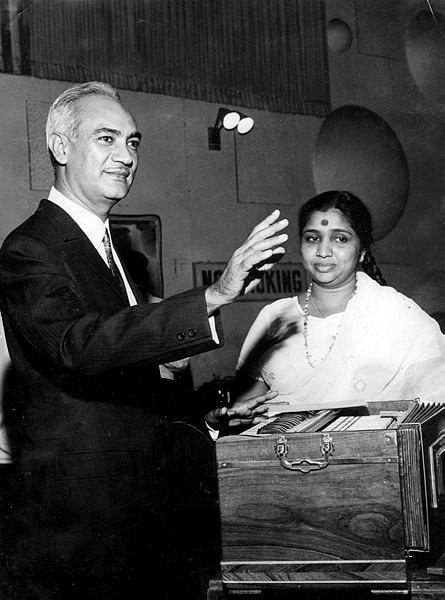 OP was probably the BOLDEST Music Director who rejected the then reigning playback queen Lata Mangeshkar, stating on record that Lata’s voice was ‘thin’ and YET was successful with hit after musical hit. In the early 1950s when he entered the film industry, he started with Shamshad Begum, went on to Geeta Dutt whose incredible versatility was something he used very well , before switching totally to Asha Bhosle.
Couple of early songs of Asha Bhosle sound somewhat like Geeta Dutt. The phrasing and intonation in two songs from Mangu is very much like Geeta Dutt. Two songs from Mangu, 1954 sound as if OP wanted her to sing somewhat like Geeta Dutt.
Man more gaa jhoomke
Dol mee man pyaar se
https://youtu.be/F_yQpxCW7PA
However only a year later in the Kishore Kumar comedy, Baap re Baap, 1955 , she had become a voice of her own. The first song of the film was the romantic and wistful Raat Rangeeli. This film also boasts one of the weirdest EVER Asha songs – picturised on Kishore Kumar! Yes – Asha Bhosle sings while onscreen Kishore tries to cheer up his wife on their wedding night . You have to see it to believe it; what’s more the film ends after this song! Weird ? Certainly,
The Asha-OP collaborations continued with multiple hits in films like Naya Daur, Qaidi, Tumsa Nahin Dekha. However in 1958, two films set the stamp on the Asha-OP collaboration . Howrah Bridge and Phagun.
Phagun had 6 Asha solos and 5 duets with Rafi. Cham Cham ghungroo bole , Piya Piya na lage more jiya were huge hits, picturised on Madhubala . Yet the song that continues to define Madhubala’s beauty and sensuousness is Aayiye Mehrbaan from Howrah Bridge. This is one of those ‘catch lighting in a bottle moment’, that will never come back. Everything is perfect in this song – including hero Ashok Kumar suavely blowing cigarette smoke and villain KN Singh giving a frown as Madhuala asks an astonished Ashok Kumar to dance with him – truly a ‘Kodak moment’, that has to be seen onscreen.
1960 had a series of superb songs that were not only hits but also musically diverse. OP always claimed that he was never formally trained in classical music . We can wonder whether this was some kind of modesty since he composed this Raag Des based song in Kalpana Bekasi had se jab guzar jaaye (There were many raag based numbers for Rafi in various films).
In the 1960s it was as if the floodgates had opened for the duo as almost every album they touched had gem after gem. Asha’s voice had also become richer and more ‘bassy’ with a wonderful lower register . Just a listing of some gems:
1962 – Ek Musafir Ek Hasina – no solos but evergreen duets with Rafi like Bahut Shukriya, Aap Yoonhi agar, Mai pyar ka raahi hoon
1963 – Phir Wohi Dil Laaya Hoon. Just one song is enough . Aankhon se jo utri hai dil mein
1964 – Kashmir ki Kali. Two lovely solos were axed in the film. That still leaves us with a load of riches as in
Isharon isharon me dil lenewaale – https://youtu.be/zNsNuCitZys
Dewwana hua badal – https://youtu.be/O0I61W2pMss
1965 – Mere Sanam.
Jaayiye aap kahan jaayenge – https://youtu.be/MpawL4IZfKg
Ye hai reshmi Zulfon ka andhera – https://youtu.be/F0hpT1R3p5Q
The former was for heroine Asha Parekh, a cry to the hero that he can never be free of her love. The latter was ‘vamp’ Mumtaz, trying to seduce the hero . Same film two contrasting emotions , each superbly sung.
Perhaps Jaayiye aap kahan jaayenge serves as a perfect epitaph as it closes with Door tak aapke peeche, meri aawaz chali aayegi.
1966 . For me, the one film that defines that year and Asha’s singing is for the ‘ghost’ film Ye Raat Phir na Aayegi. By this time she was wonderful in the lower registers , with a deep ‘bassy’ tone which worked wonders in the ‘ghost’ songs where the ‘ghost’ is calling the hero to be with him. 4 solos and 3 duets meant that the sole male solo by Mahendra Kapoor, though good, was largely ignored in favour of these six songs.
Yehi Woh Jagah Hai – https://youtu.be/lUWbc5MaTI0
Main Shayad Tumhare Liye – https://youtu.be/Kcn4X_SgkKM
Har Tukda Mere Dil Ka – https://youtu.be/2E0kmQiUZaY
Huzurevala Jo Ho Ijaazat (with Minoo Purshottam) – https://youtu.be/-6ym4uOOtEo
Mohabbat cheez hai kya (for Mumtaz) – https://youtu.be/x2y_7ne7oFY
Jumping to a flop film but whose music was still a hit – Humsaya. The lone Rafi solo Dil ki aawaz bhi sun was somewhat overshadowed by four Asha solos . Someone once said that OP was a ‘Pilu’ specialist and here that saying comes true with the not so popular Oh Kanhaiya picturised on Sharmila Tagore – https://youtu.be/lGTHiZ2hAS8
Mala Sinha had the more important role, as the Chinese wife of hero Joy Mukherjee (too complicated to explain here) and thus got three solos again giving a chance to show the versatile nature of Asha’s singing. Since
Woh Haseen Dard De Do – https://youtu.be/Cpadpk2zFt0
Aaja Mere Pyar Ke Sahare – https://youtu.be/41z-4LEgRZ0
Kitna Haseen Hai Yeh Yahan – https://youtu.be/A0jFQvB-MjI
For those who wax poetic about how RD made Asha sing for two actresses in two different ways in the song from Caravan, Ab jo miley hain, OP had already done that in Humsaya in the Mahendra Kapoor – Asha duet . The song Badi mushkil se kaabu me dile diwana aaya hai had Kapoor singing for Joy Mukherjee. The second antra/ stanza has Asha singing for Sharmila Tagore . It is in the third antra/ stanza that we feel the difference as it is ‘flat’ / ‘straight’ style for the Chinese character played by Mala Sinha
OP seems to have some kind of jinx for the number of songs that were recorded, became popular and yet were axed from the films. These included :
The superb duet Mai pyar ka rahi hoon – https://youtu.be/3O1EyoQ6cqk
Another superb duet Humne to dil ko – https://youtu.be/iTVpBRB4cVc
Two solos from Kashmir Ki Kali
Balma Khuli hawa – https://youtu.be/eKwGxf9TfAA
The raag pilu based Phir thes lagi – https://youtu.be/MhifLHeqpTI
We suppose all good things come to an end for one reason or other. The 1972 film Pran Jaye pa Vachan na Jaaye was a fitting finale to the OP-Asha collaboration with a perfect epitaph in
Chain se humko kabhi, aapne jeene na diya
Zehar bhi chaaha agar, peena to peena na diya
The minimalist orchestration also helps in bringing out the rich ‘bassy’ tone of her voice.
This is my small effort to remind all musical fans that OP had a HUGE part in Asha’s overall range and works .
Part 2 will also be about the non-RD composers, some non film gems and how there were many songs that were equally well known and even defined her. (And maybe some RD favorites)
K V Ramesh
April 13, 2026
Very good tribute to the legendary singer. O P Nayar and Asha Bhosle songs were a big hit.
I think her other songs like Nigayen milane ko jee chahtha hai Roshan was also very good.
Indeed. Coming up in part 2
KVR
Wonderful tribute – especially recognising the contribution of OP in shaping Asha for Bollywood. You have highlighted those rare gems that do not get much public love – and that is the star of your piece. Geeta Dutt is another gem of versatility as you have rightly pointed out. I am not much of a “film” person so it was nice to have backgound context of the films and situations in which these songs appear.
I love OP’s swansong – Chain se humko. Its minimalist approach truly highlights Asha’s depth of artistry. The only song that can rival it is the Marathi one “Jeevalaga rahlie re dur ghar mazhe” from the album mentioned below – composed by her brother, Hridayanath Mangeshkar circa 1965-66.
I hope you (or someone else) also contributes to the side of Asha’s singing that is not much visible to Bollywood fans – her Marathi songs – which were also responsible for her growth in the decade of 1950-60 – particularly her collaboration with another legend, Sudhir Phadke (Babuji). Asha’s pure classicicism is visible in the album “Madhumilanat Ya” which lists 10 Natyageet from 1954-58 which are outstanding – priceless gems – with just a harmonium (organ) and tabla mostly.
Thank you for Part 1 – eagerly awaiting Part 2.