
Mai Wapas Aaunga (2026) – Poignant, Superb film
Genre: Drama – based on Partition
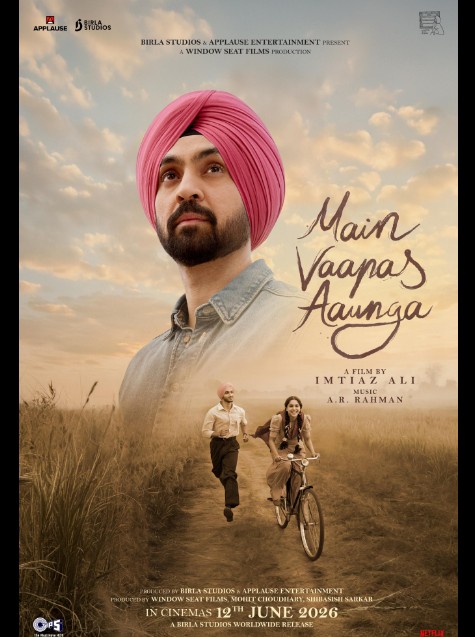
Platform: Theatrical release
Director: Imtiaz Ai
Time: 2 hours 46 minutes
Cast: Naseeruddin Shah (Ishar Singh Grewal). Vedang Raina (Keenu / Young Ishar Singh Grewal). Diljit Dosanjh (Nirvair Singh). Sharvari (Afsana/Jiya).
Plot: In the present , 95-year-old Ishar Singh Grewal is driven by the family driver to Attari check post , at the Indo-Pak border, since he wants to go to Sargodha. The BSF officers at first mock him but then quickly understand that the dementia-stricken Grewal needs medical care. In London. Ishar’s grandson Nirvair is trying various jobs while his heart is in standup comedy. He returns to India and is at his grandfather’s bedside, not dismissing his dementia-stricken words as nonsense but starts searching for the meaning and the events behind the words like Martians, Government College, curse of the women, and so on …
Partition stories mostly follow a similar pattern – tragedies, massacres, depredations on both sides, and of course the super human superman strength of Gadar 1 and Gadar 2. Rare is the film that delves into the meanings behind the words and ultimately what was the HUMAN EXPERIENCE that ended up as words and books.
This film had me choking at various moments not because of the Partition tales but because of the fact that finally there IS a “meeting of minds” among the family members who used to dismiss the “old man and his rants and ramblings”. Nirvair slowly and steadily gathers the pieces of the “Keenu’s” journey from undivided India to post Partition India and finally what was it that was keeping his grandfather alive. As the grandson, he cannot in any way relate to the stories till the time he finally understands his grandfathers’ experiences. For others they are words; for him and his grandfather, they are life experiences that still don’t have a closure.
Nirvair’s unsettled life in London, contrasts with that of his grandfather, the young ‘Keenu” who likes and chases the young Jiya. Both are unaware of the impending disaster called Partition. Keenu, actually tells the local gangster who is threatening his life, that he wont go from this place and he can do whatever they want with him, since it is not written whether their town will be in India or Pakistan. It is somewhat crazily funny and dangerous in the same breath as no one is sure what will happen.
Partition films generally do not talk of healing and closure but to show the gradual ascent to bestiality on both sides of the communal divide. Normally they also talk about a lost time and era which appear as sepia tinted photographs. Bitterness. Longing. An Open Wound – all these and more have been covered in multiple films.
Chaliya (1960) was a rare film that spoke of healing on both sides as the Indian side adopts the sister of the Pathan as their own while the Pathan adopts the heroine’s child as his own. It wasn’t a big hit though the songs were exceptionally popular. In the modern era, Gadar , Border and a host of such ‘kill all Pakistanis’ type of films have been hits, no doubt due to the political climate in which they have been released. All the characters were cardboard cutouts.
So, we can actually relate to a Keenu and Nirvair’s bewilderment as they go about trying to unravel the happenings. Keenu’s loss of innocence is balanced by Nirvair’s loss of innocence in that he finds that he doesn’t belong in London but in India. Keenu knows that he has lost everything yet has to seek out Jiya and it is this quest – like most stories centred on quests – that forms the core of the film.
The trailers say this is supposedly based on a true story; yet we cannot be sure as there would have been hundreds of such stories. The historical background is of course very much true as millions on both sides found a new life albeit with a sense of loss and the possibility of no return to their roots. In the final analysis, that’s what the film is all about – the search for one’s roots.
I saw the film on June 18th in a theatre in an evening show. The same day in the afternoon I had watched on Amazon Prime the TV series, “Made in India: A Titan Story”. Naseeruddin Shah was JRD Tata in the TV series and the same evening he was the dementia-stricken Ishar; the contrast couldn’t be more dramatic. This is Naseer’s film from start to finish, and he is incredible despite spending almost all the film on a bed. Diljit Dosanjh is also good as the grandson who starts the quest which his grandfather couldn’t and, in the process, realises more about himself than he thought was possible.
In the end this is NOT about politics or religion but the quest for completion, closure and always memories. The onscreen duo seeks it in their own way. Relentlessly.
The films end shows the multiple wars worldwide that contribute to multiple ongoing refugee crises; and how the rootlessness of the refugees leads to an overall loss and despondency.
DO NOT MISS IT AT ANY COST. It will be worth it. These days, rare is the film that makes me want to go back to the theatre and see it again. This is one such film.
And I feel like saying “Mai waapas dekhunga”. 😊
Script – 5 out of 5
Story – 5 out of 5
Direction – 5 out of 5
Photography – 4 out of 5
Total – 4.8 out of 5
shall definitely watch.
Hi Rammesh,
Read your review of this film, three times. It is evident – from your prose and sentiment, that this one is straight from your heart. I hope to watch the film soon.
Naseeruddin Shah – easily one of the finest actors of our age; Diljit Dosanjh – a fine, subtle, soft actor, and I hope he does not lose himself in inane films.
….
The Partition of India – after having read two books on the subject a few years ago, I decided to not touch this subject any more – it is too heart-wrenching, too bloody and emotionally disturbing. A tear in the fabric of that entire region, one which will never be repaired. (or cynically, exacerbated forever, by those who benefit by division and rancor).
Still, there is no getting away from it. Just recently acquired Sam Dalrymple’s ‘Shattered Lands – Five Partitions And The Making of Modern Asia’ (2025 publication).
An excerpt from Chapter 8, ‘A Red Dawn’:
“In Punjab, the violence had spiralled so out of control that Mountbatten had assigned over twenty two thousand soldiers to a Punjab Boundary Force, meant to keep the peace. Woefully undermanned in a province of fifteen million people, the soldiers were soon calling themselves the ‘Poor Bloody Fools’. Many of them expected to face major criminals but instead found themselves confronted with well-trained militias. Sikh maharajas armed jathas with rifles and grenades while Muslim aristocrats like the Khan of Mamdot smuggled war-grade munitions to private mercenary squads”.
…
Slightly off-topic, but the subject of human migration in the 1940s-50s period is another tale of epic human suffering and tragedy, but still, with the human spirit to simply survive and try find a safer spot in the god-forsaken world then:
– African-Americans – from the racist South to the northern states. But at least, no Holocaust;
– The Jews of Europe (10 million refugees)
– India/Pakistan, born in blood.
—
Thanks…
Robin
Leave a Reply
Want to join the discussion?Feel free to contribute!