
The 1950s saw The Cold War take off spectacularly. The two sides kept staring at each other and made worldwide alliances based on ideology. For all its talk of “Democracy”, the US supported unpopular dictatorships with terrible Human Rights records (Guatemala, Paraguay, Argentina, Zaire, etc.). The Socialist Bloc wasn’t far off, often crushing democratic dissent with force (Berlin 1953, Hungary 1956, Czechoslovakia 1968). With the alignments clearly marked out, it was just a matter of time before one of the two blinked and unleashed Nuclear Doom on the planet.
Thankfully we know that didn’t happen, but with a post-Cold War World being totally uncertain with multiple alliances and blocs, we can’t be sure whether the terror of Nuclear Annihilation has been eliminated altogether. On the contrary, The Doomsday Clock seems to be ticking with more vigor (https://en.wikipedia.org/wiki/Doomsday_Clock).
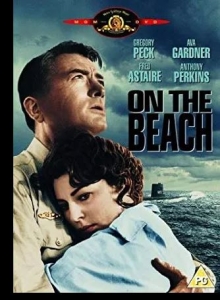
The 1958 film On the Beach shows what happens when two Blocs collide and Nuclear War is unleashed. In an era when “winnable nuclear wars’ were the flavor of the day and civilians drilled for nuclear war “safety” https://youtu.be/120wGLgCTkg .
The film version of Neville Shute’s book was not popular and flopped.
It’s 1958, and somewhere over the Northern Hemisphere, “The Cloud” is drifting slowly to the Southern Hemisphere, blown by the currents. The Cloud resulted from multiple nuclear detonations in the Third World War. It is filled with radioactivity, wiping out all life and every living thing in its path.
The Cloud is now drifting toward Australia, unaffected by the nuclear exchange. However, fuel is scarce, and all travel is by horse cart, cycles, the limited number of trains, and so on. US Navy Commander Towers (Gregory Peck) and his nuclear-powered submarine USS Sawfish (actually a diesel-powered Oberon class sub, “acting” as a nuke sub) have docked in Australia. The crew is aware that something has happened but does not know the extent of the disaster. Towers takes the help of the Australian Navy to stock up on provisions. Australian Navy Lt. Peter Holmes(Anthony Perkins) is assigned to the sub. Towers meets Moira Davidson (Ava Gardner), supposedly the town drunk and tramp rolled into one. Holmes and his wife Mary (Donna Anderson) are new parents worried about their baby’s future.
Meanwhile, The Cloud is advancing steadily toward Australia. Most Australians do their best to be happy and enjoy life but can’t help but think of “these days” and “lack of hope”.
Towers is asked to check out a faint transmission from San Francisco. He, Holmes, scientist Dr. Julian Osborne (Fred Astaire), and his crew take their sub to San Francisco. Through the periscope, they see a devastated city. One of their crew members assigned to check out the transmission finds a dead land devoid of any life. He loses all hope, removes his protective suit, and decides to fish in the contaminated waters. The sub leaves without him and reaches Australia.
The Cloud is now closer to Australia. Increasingly there is a flurry of all sorts of activity – the hoarding of foods, religious preaching. Law and order seem to be breaking down. The Cloud is much closer to Northern Australia. Things start going downhill.
If you find such stories “gloomy”, “depressing”, and “non-entertaining” and do not want to see the film, then you should see it all the more. This is one of those rare screams for sanity in an era when concepts of “winnable nuclear war” and the soon-to-be infamous “MAD – Mutually Assured Destruction” (the early 1960s) were backed by equally potent weapons of mass destruction. The Hiroshima and Nagasaki bombs of 1945 “Kiloton vintage” looked like childish firecrackers against bombs whose “yields” were calculated in hundreds of “Megaton power” and which the two powers regularly detonated.
British writer Neville Shute who specialized in aviation stories and war dramas wrote the book in 1957. While the effects of radiation were still being understood, the writing on the wall was clear. In all this technological apocalypse, what was to happen to the humans that these technologies were meant to protect? What exactly is a “winnable nuclear war”? “Who wins”? And who actually “loses”? What about “After the war?” Most strategies do not answer that one question “What about After”.
“The living will envy the dead”. This is a statement attributed to Albert Einstein or Nikita Khrushchev – no one knows the truth about who said it, but this should have been the selling/tagline for the film. On the Beach answers the question and SHOWS what happens in such a scenario. How the living will dread each day. How each day and hour become about survival. How prized possessions suddenly lose their meaning. How “family” becomes just a term and the saying the “family that prays together stays together’ assumes a new chilling meaning.
Can you really survive a nuclear war?
The Black and White photography is highly effective. The bleak reality comes through, and we cannot imagine the landscape in color and are forced to think through the colorless perspective. What would be one’s last thoughts? What will happen to your favorite possessions? Finally, what about your loved ones? Be it Holmes’ family or Tower’s newfound love with Moira? Is there a tomorrow?
All the performances are absolutely spot on though Fred Astaire looks slightly miscast as a scientist. You have to see the film to understand. The film builds up spectacularly to its chilling climax.
Stanley Kramer has worked on multiple genres and can’t be pinned down to any one genre. His brilliant comedy “It’s a Mad Mad World” was in the future as was his homage to American racial equality “Guess who is coming to dinner”. The direction is taut, and we are left guessing as to “WHAT will happen next” – all the time!
The End – pun intended – is but natural.
The film is available free at https://archive.org/details/on-the-beach
Script – 5 out of 5
Story – 5 out of 5
Direction – 5 out of 5
Photography – 4 out of 5
Total – 4.8 out of 5
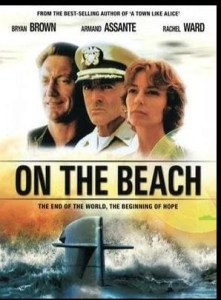 The film was remade for TV in 2000 with an equally stellar cast. In 1958, no one knew how a nuclear sub looked outside and inside. That small omission is corrected with an impressive “nuclear sub” that goes to a totally devastated San Francisco (chilling view of famous landmarks) and returns to Australia, now facing The Cloud and its inevitable consequence. While the earlier version showed only empty streets, the color version shows empty streets and families inside buildings and what happened to them. Chilling.
Armand Assante (Towers), Rachel Ward (Moira), her real-life husband Bryan Brown (Dr. Julian Osborne), Grant Bowler (Peter Holmes), and others do a stellar job in this three-hour movie. You may think that a remake may lose its charm or power. However, the color remake does full justice to the original story with only a minor variation. In the final shot, Tower and Moira are together – but happily ever after?
A small observation. As befitting those times the 1958 US Navy is a totally “white” Navy while the 2000 version has a much more “integrated” crew.
Any madman who screams of “blasting the enemy to the stone age” should see this film – both 1958 and 2000 versions. The argument that nuclear weapons have kept the world at Peace is absolutely ridiculous if not cynical. After watching the film, you MAY think otherwise.
The color version is equally excellent and also is free at https://youtu.be/j6imEMekIt4
As for the term “On the Beach”. It means a ship that is retired from service. Think about it.
Leave a Reply
Want to join the discussion?Feel free to contribute!