
Genre – War Movie (true story)
Time: 1 Hour, 58 minutes
Platform: Netflix
Director: Krzysztof Lukaszewicz
Language: Polish
During WW2, every occupied country in Europe suffered untold horror and privations but none so more than Poland. It was the first to be occupied by armed conflict (Austria and Czechoslovakia were occupied without a shot being fired). To add to its woes, the Germans invaded from the West. Weeks later, the Russians invaded from the East, splitting the country into two occupied zones and committing atrocities. The Germans perfected various exterminations methods: from Mass Shootings through Gas Vans to finally Death Camps in occupied Poland. The Russians ruthlessly shot their prisoners (refer earlier post on Katyn).
Members of the Polish Government and Military formed a Government in exile in London which was Royalist and anti-Communist. Once the Germans attacked the Soviet Union, the Russians also formed a Communist Government in exile from the captured POWs and committed Polish Communists in exile. Stalin refused to recognise the “London exiles’ as the authentic government and called them gangsters and severed relationship with them. The mysterious death of the London based Polish leader , General Sikorski, in a plane crash in Gibraltar, which was and is British held territory, added to the feud. In Poland, the Resistance movement was split between London and Moscow, with neither side endorsing the other.
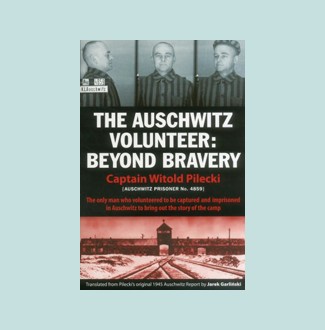
Understanding this background is crucial before watching this movie, as the narrative constantly jumps between the past, present, and even further back. (Somewhat like Nolan’s Oppenheimer). Witold Pilecki’s story is unbelievable as he is one of the three or four people who intentionally allowed themselves to be captured so as to penetrate the Auschwitz Death Camp.
Witold Pilecki was a cavalry officer whose regiment was decimated in the German attack and who soon was part of the Polish Underground, loyal to the London regime. Pilecki discreetly documented dates and times of massacres and rumours of death camps. These reports were sent to an unbelieving London Government who asked for more proof. Pilecki then did the impossible; he allowed himself to be captured and deported to the Auschwitz death camp. Despite not being immune to the harshness and privations, he was able to organize a resistance movement inside the death camp. After getting enough proof he escaped from Auschwitz and reported back to the local ‘government’ who forwarded his reports to London who further pressured the Allies to bomb the camps or at least the railways carrying the death trains. The Allies did nothing.
 With the tide of the war turning, the Russians mounted huge assaults that swept the Germans out of Russia and brought them to the gates of Warsaw where they waited. Taking the opportunity, the Polish “Home Army” loyal to London, revolted and The Warsaw Uprising began that lasted for 65 days with an inevitable outcome of the Poles being brutally crushed while the Russians waited on the eastern banks of the Vistula river. The official explanation is that they exhausted their supplies, yet evidence suggests they were instructed to do so. In the meantime, the Polish Communists formed their Government at Lublin, which soon became known as the Lublin Government, whose every step was monitored by Moscow.
Following the liberation of Poland from German control, the Lublin Government initiated a search for individuals who had aided the London-based Home Army, determining their future as free individuals. Thus Pilecki survived Auschwitz but not the Communist beatings and tortures, leading to his execution at the hands of the Polish Communist Secret Police that later became the Polish UB (the counterpart of the KGB).
The movie begins with Pilecki’s arrest and alternates between the aforementioned events, potentially bewildering viewers who are unfamiliar with the complex Polish history during the German Occupation and the conflict between 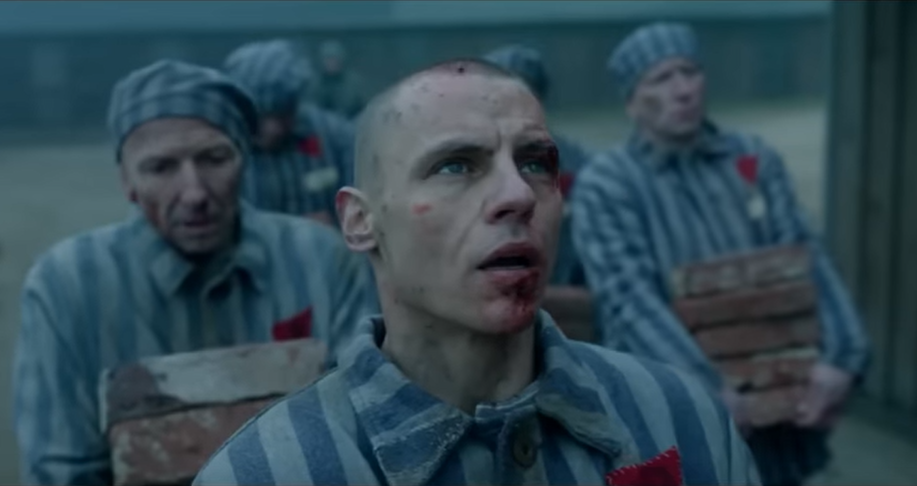 Communist and non-Communist Exiled Governments. Pilecki is arrested, interrogated gently at first, and then subjected to escalating levels of physical torture. His wife’s letter to the exiled Polish General Anders is taken as ‘proof’ that he has been in ‘contact with Western spies’. Pilecki’s contention that no one released him from his officer’s oath to the Western armies falls on deaf ears. The Auschwitz scenes are also recorded by him and narrated to his unmoved Communist interrogators.
His incredible story became known only in the early 21st century, due to the complexities of the Poles being torn between their post WW2 communist past and their emergence as a full NATO member.
The film is too clever by jumping back and forth , soon losing the narrative, especially to foreign audiences, who do not know the history.The script is the culprit here. If the film had a linear narrative, it would have been much better. We can then not only understand the complex background to the story but also place the characters in the right time and place.
We can only marvel at such stubborn fortitude not only of Pilecki but of Poland who refuse to be bowed by larger forces, especially Russia. The Polish – Russian antagonism continues till date as each views the other with intense suspicion.
The film is available on Netflix
Real History/ Historical Background – 4 out of 5
Script – 3 out of 5
Story – 4 out of 5
Direction – 4 out of 5
Photography – 4 out of 5
Total – 3.8 out of 5
Hi Rammesh,
Will add this film to my Netflix list.
Witold Pilecki – this is an extreme example of bravery. No words to describe it.
Entering any Holocaust Museum anywhere becomes an experience of dread and anguish, especially when entering the ‘Poland Exhibits’.
Copy/pasting from Google Search:
“Nazi Germany established a vast network of hundreds of concentration, extermination, labor, and transit camps throughout its occupation of Poland. The system included major camps, their numerous subcamps, and various smaller sites, making a precise single number difficult to pinpoint.
Key types of camps included:
Extermination Camps: Six camps were established specifically for mass murder as part of the “Final Solution”:
1 – Auschwitz-Birkenau (which also functioned as a concentration and labor camp complex)
2 – Chełmno
3 – Bełżec
4 – Sobibór
5 – Treblinka
6 – Majdanek (often classified as a concentration camp with a killing center)
Major Concentration Camps: In addition to Auschwitz and Majdanek, another major concentration camp was Stutthof.
Subcamps and Other Sites: Each main camp had numerous satellite or subcamps. For example, the Auschwitz complex alone had over 40 subcamps, and Stutthof had around 40 officially recognized subcamps. There were also hundreds of forced labor camps (Arbeitslager) and other detention sites across occupied Poland.
The United States Holocaust Memorial Museum estimates that between 1933 and 1945, the Nazis and their allies established more than 44,000 camps and other incarceration sites across German-occupied Europe, a significant portion of which were in Poland. These camps were an instrument of terror and forced labor, ultimately leading to the murder of millions. “