
The Seven Samurai (1954) – and its Indian inspirations.
This is my 200th Post since November 2022 . I have been steadily posting every sunday and I wanted something special and chose the classic The Seven Samurai
Clickable Links in red
It can be argued that Akira Kurosawa’s film The Seven Samurai is highly influential worldwide as it put post WW2 Japan on the world cinema map. At the same time, Japan continued its string of ‘regular Japanese masala films’, like Godzilla – originally titled Gojira (1954) – continued and that too put Japanese cinema on the world cinema map.
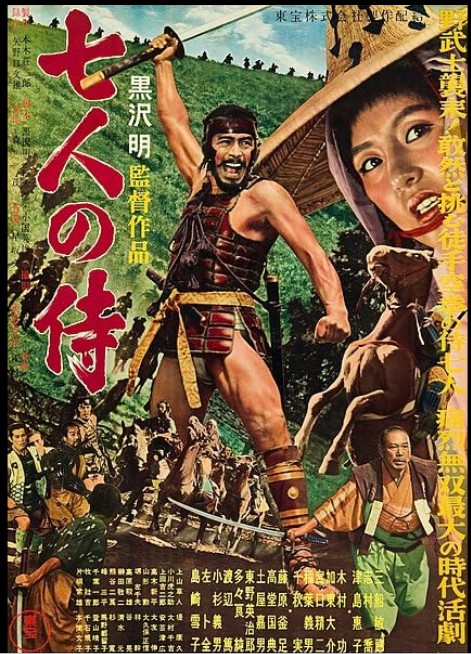
The Seven Samurai has been exceptionally influential worldwide. The concept of a small town / village hiring mercenaries to defend itself against the depredations of local bandits who regularly harass them, proved cinematic gold. Hollywood made the first adaptation, which was virtually a copy-paste with localization into the Western genre. The Magnificent Seven (1960) gave ample scope for the employment of the disparate group of mercenaries, each with his own special skill. Even the young idealistic Samurai, who joins the experienced warriors, was copied as the young gunman, played by first time actor Horst Bucholz, who joins them. The same film was remade in 2016 but the original was the original. Return of the Seven (1966) with only Yul Brynner from the original cast, as the leader, proved that the magic of the original will always remain the original and any follow up would pale in comparison , which is what happened. The Wikipedia page of Akira Kurosawa cites some 10 worldwide inspirations and only 1 Indian inspiration, which only means that you can rely on Wiki only so much :). By my count there are at least 4 Hindi film inspirations and probably more that I am unaware of in other Indian languages. A google search ridiculously mentions Tamil film Thalapathi(1991) as one among many inspirations, while everyone who has seen the film knows that its a modern twist on the Karna-Arjun story from Mahabharat..
Except for Sholay, the other films are all available on You Tube. So, here’s my take on the inspirations that adhere to the formula “village hiring mercenaries to save itself from cruel dacoits”:
Mera Gaon Mera Desh (1971) – or One Samurai!
Casual criminal Ajit (Dharmendra) is hired by ex-Army soldier turned villager Jaswant (Jayant) to defend a village against a dreaded dacoit Jabbar (Vinod Khanna). After the initial false starts, Ajit soon starts liking village life to the extent of falling in love with a local lass Anju (Asha Parekh). Things turn a bit complicated when Jabbar’s mistress and nautch girl Munnibai (Laxmi Chaya) also starts liking Ajit and wants to wean him away from Anju.
Raj Khosla’s reputation as a “hit film maker” solidified with this film which was a perfect masala of story, action, dialogues, songs and charismatic main characters played by equally charismatic lead actors. Vinod Khanna’s reputation shot up after his role as Jabbar. Dharmendra was already on a roll as a bankable action star and so too Asha Parekh as a dependable leading lady. What’s unusual is that Laxmi Chhaya also got equal if not more footage as the semi vampish woman who finally sides with Ajit and naturally pays the cinematic price for doing so. The music by Laxmikant Pyarelal delivered one memorable song after another and what’s unusual is that Laxmi Chhaya, the vamp, had three songs picturised on her: “Aaya aaya atariya pe koi chor”, “Hai sharmaun kis kisko bataun” and the most famous of them all ‘Maar diya jaaye ke chhod diya jaaye”. What’s also unusual is that Lata Mangeshkar sang all the three songs for the vamp and also two for the lead heroine – the solo ‘Sona le jaa re” and the superb duet with Mohammed Rafi “Kuch kehta hai ye sawan” which hovers around six notes. The film preceded Sholay by a full four years and was a huge hit. The villages around Udaipur added to the authenticity of the rustic tale of one village against dacoits.
Watching it a few years ago on You Tube, I was struck by the fact that it still seemed fresh – if one doesnt unnecessarily compare with today’s films and understands the times in which it was made. (That applies to all the films discussed below)
My Rating – 4/5
Khotey Sikkey (1974) – or Five (and a half) Samurai meets The Man with No Name.
This is a clever mix of For a Few Dollars More and The Seven Samurai. Here it is dreaded local dacoit Janga (Ajit) and his depredations for which one of the villages sends Ramu (Paintal) to bring his cousin brother Jaggu (Narendranath) back to the village along with his friends Danny (Danny Denzongpa), Bhaggu (Sudhir), Salim (Ranjeet) , a wrestler and his midget friend. They soon encounter a lone man on a horseback (Feroze Khan), always dressed in black and whose name no one knows . Soon the six (and a half) band together to defend the village against Janga.
While the Seven Samurai part is clear, the Dollars part becomes even more in the segments dealing with Feroze Khan and his quest to take on Janga alone. The ticking musical watch that serves as the start of the killing of a police informant and in the long drawn out climatic fight between the duo – all these are a straight copy-paste from For a Few Dollars More.
The digressions and localisation are in the shape of Danny bringing his city girlfriend Reeta (Alka) to the village, a courtesan Paro (Rehana Sultan) being courted by the Man with No Name, Jaggu slowly liking the much-harassed widow Madhu (Madhu Chanda), Bhaggu the inveterate womaniser and the five goons being a mix of religions and communities. They are the ‘khotey sikkey’ – the fake coins – of the title that ultimately prove to be the ‘true’ coins. Writer Director Narinder Bedi does an excellent job and the overall action and plot is very much in keeping with the ethos and story of The Seven Samurai. In such a film, music can be a double-edged weapon as none of the main ‘Samurai’ can be seen singing. So, it is left to the horseback rider’s father singing in a flashback, Jeevan me tu darna nahi, which he sings to the village children and recurs as a refrain from time to time. Since Paro is a courtesan, she does the obligatory mujra number, Pyaari pyaari suratwaale. It might feel slightly kitschy but that is true for most films made in the 1960s and 1970s.
This is as enjoyable as they come even if it feels tacky at times.
My rating – 4/5
Sholay (1975) – or Two Samurai.
There is nothing much that can added to the classic and it still remains a perfect masala film with an equal share of comedy, tragedy, action, emotion and music. The recent release of the restored version with the original ending of Thakur killing Gabbar Singh , and its immediate aftermath of Thakur weeping as he has lost his life purpose, is far more powerful , than the original limp ending of Gabbar being led away by the police which was under political pressure about ‘law and order forces should be seen to triumph’ . That kind of dogma would soon be upended by a series of films where the main character would have shades of grey . As someone said, Hindi Film Industry can be divided into two eras – Before Sholay and After Sholay.
Both Amazon Prime and Jio Hotstar have the prints with “original” ending of Gabbar being handed over to the police!
My rating – 5/5
China Gate (1998) – or Seven “Old” Samurai 😊.
China Gate is the ONLY film that I know of where at the start of the film, there is a tribute to Akira Kurosawa and his film The Seven Samurai. Given this tribute, this film is a nice twist on the “Seven Samurai Universe” in that they are not mercenaries but seven ex-Army soldiers who had been cashiered/ court martialed for a critical anti terrorist operation that went wrong. All of them have been branded as cowards and their court case was also thrown out. The seven are old, surviving on odd jobs, facing private humiliation, generally past their best. Their old C.O. Colonel Krishnakant Puri (Om Puri) has faith in them, but the old men are not so sure. They are at the village to combat Jageera (Mukesh Tiwari) under the invitation of Sandhya (Mamta Kulkarni) whose father and Puri had been friends. There is also a would-be Samurai, a young runaway who wants to join the Army and thinks that being with the Samurai will teach him how to do it – this fulfils the original “young fresh samurai” formula.
Rajkumar Santoshi’s tribute is well made and has superb action sequences with the ‘old’ Samurai doing what they do best. There is a localization with a corrupt cop (Paresh Rawal) demanding that the seven show their arms licenses and generally trying to be obstructive. He is even friendly with Jagira and wonders out aloud “Better to be friends with them ; who knows tomorrow they may end up as politicians”. There is also the Hindu-Muslim tension in the form of the long feud between Colonel Keval Puri (Amrish Puri) and Major Sarfaraz Khan (Naseeruddin Shah). Depending on how one sees it, it’s a bit of fun to see the ‘old timers’ saving the village from the dreaded dacoit. Musically the number ‘Chamma Chamma’ for a special dance number by Urmila Matondkar, was a chartbuster. The posters and promos were all of her in the song costume while she was there only for the song. There were some rumors / press reports that the ‘heroine’ Mamta Kulkarni was upset at the director for not including her in the promos.
I didnt want to see it as I was sure it would be a disaster. Yet I saw it on the last day last show (9:30 pm) at Metro cinema in 1999. I wasnt sorry that I saw it and enjoyed it. Even Jageera was good and suitably nasty.
My rating – 4/5
In summary, these four Hindi make the grade perfectly. If there are any films in other languages that fulfill the ‘formula”, do share.
What’s your take on these Seven Samurai clones? Do you know of any other films that STRICTLY follows the “mercenaries hired by a village/ city” formula? Share your thoughts and do write in.
6 responses to “The Seven Samurai (1954) – and its Indian inspirations.”
-
A massive and really inspiring achievement! You now have an archive that people can trust to get the best of the best in your unique niche. Can I just say that your enthusiasm and detailed is so contagious and fun. You really engage with details in a way that makes your work authoritative, and fun too. It reminds of a tidbit around how a lot of archeaological/heritage work in India was done by enthusiastic government teachers who took out their bicycle to explore the countryside. I meaningful way to live if anything. Congrats and keep at it! :D
WRT the post: I really enjoyed Seven Samurai, and coincidently was going to watch Rashomon this week too.
-
Fantastic and Nostalgic – back to school days!
Lovely to read about the details which are hazy after decades.
One possible entry could be Kaala Sona – Feroz and Danny – a kind of two Samurai with 2 girlfriends. But my memory is vague.
There was also a film called Saat Hindustani (Amitabh?).
Anyway, great article. Keep it going. All the best.
-
Hi Rammesh,
Congratulations on your post ! In this world of forgettable/depressing/inconsequential news, they are certainly something to look forward to you! Adds a bit of mirch-masala to the week.
—“The concept of a small town / village hiring mercenaries to defend itself against the depredations of local bandits who regularly harass them” – Hindi/Indian films
Have to think of this some more..but does ‘Ramgarh Ke Sholay’ count? I have not yet dared to view this film!
__Cheers…
-
🤣🤣 Ramgarh ke Sholay and RGV ki aag . Now why didnt I think of those 🤣🤣
KVR
-
-
Congratulations on hitting 200 posts! Hats off to your consistency. I haven’t watched the original Seven Samurai and your post has convinced me to correct that at the earliest.
Of the Indian adaptations, I’ve watched Sholay and China Gate, and the latter has weirdly been one of my favourite movies to rewatch. I think Jageera as a villain is a bit overblown but everything else works well for me, including the lovely Alsation dog that Amrish Puri’s character has a problem with until the end, where he takes on his care. :D
-
Hi Gowri
Thanks. Jageera has to be overblown, given that there would be comparison with other “iconic” (how I hate that word for being overused) villains like Gabbar SIngh, Mogambo and so on.
As for the original, once you watch it, I am sure you will feel these are but pale imitations. Its available on You Tube but you the auto translate leaves much to be desired !
KVR
-


Leave a Reply