
Pather Panchali (1955) – Classic / Apu Trilogy part 1
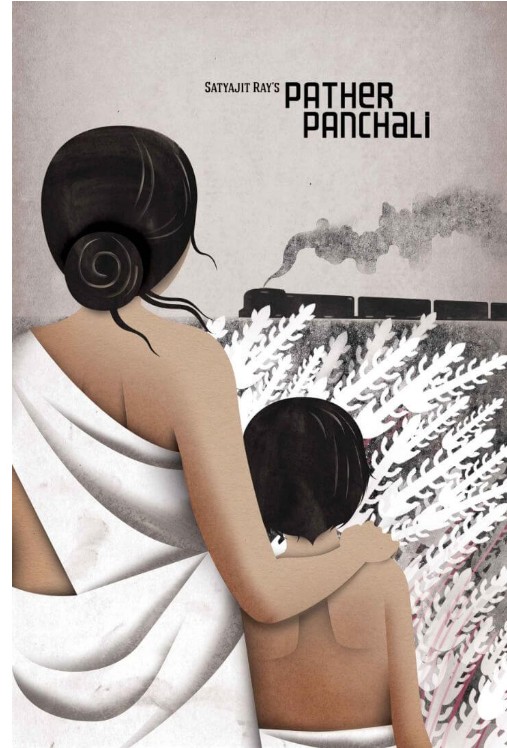
Genre: Human Drama
Platform: Amazon (Rent) You Tube Free
Time: 1 hour 50 minutes
Director: Satyajit Ray
Cast: Kanu Banerjee (Harihar Roy). Karuna Banerjee (Sarbajaya Roy). Subir Banerjee (Apurba “Apu” Roy). Uma Dasgupta (Durga Roy). Chunibala Devi (Indira Thakrun, the old aunt).
Plot: Apu is born to a poor priest Harihar, who is struggling to make ends meet with his wife Sarbajaya, and their daughter Durga. His wife resents the presence of an old aunt, who she feels is spoiling her daughter. Hari goes out of the village to multiple towns to earn money while Apu grows up in the village, learns about village life and sees the world through his innocent eyes. Sarbajaya worries about the lack of food, money and news of Hari…
The story by novelist Bibhutibhushan Bandyopadhyay was published in 1929. The film places the events in the same time period and has a total rural ambience including practices of the rural areas such as a village play (jatra), child marriage of girls who are generally uneducated , being married off at a very early age and an overall sense of rustic peace which will be surely broken by some kind of calamity.
The overall atmosphere is hardly doom laden but is filled with innocence as Apu sees the world through his eyes and cannot understand why his mother is slaving all the time , cooking, generally helping around while his elder sister Durga is playing with girls of her age . There are minimal dialogues as everything is visual , as Apu sees it. There are no cliches that one expects of films set in rural areas, such as the bad zamindar, the sly/ sympathetic priest , and so on. The village mostly has women doing all the hard household work. The men are barely seen.
Hari is essentially an optimist who feels that “the city’ will have more money and wants to try his chance there. With his meagre belongings he goes off to the city and thus starts Sarbajaya’s agony – not knowing what’s happening. The rare letter that arrives is usually rushed by Apu crying out aloud the arrival of a ‘chitti’. That the family can read is attributed to Hari being a Sanskrit teacher and helping his family to read, while composing stories and poems .
The supposedly simple village life is not all that simple as it appears to be. Sarbajaya is losing both her mental peace and must borrow money, leading to taunts and pressure from her lenders, to pay up or else. The expected tragedy as and when it happens is something that no one is prepared for. Apu also can’t understand what’s happening except that he sees his elder sister is not around any more . Durga’s death attains a more poignant tone when Hari returns with money from his various city jobs, including clothes for the family and learns of Durga’s death.
The final shot shows that Hari has had enough of the sufferings in his village and is leaving his village for the city. A snake entering Hari’s derelict broken house is the symbol that the house is inhabitable for humans. Its amazing that as early as 1929, someone had addressed the essential reason for migration from a simple rural life to an existence in a harsh uncaring city. The stage is set for part 2 and part 3 of the trilogy.
Overall the feeling of the film is like a blank canvas on which colours and shades are slowly filled. The poverty is not bleak but somehow the couple manage and finally throw in the towel. They may have been defeated for the time being but there are new adventures ahead, as seen through Apu’s eyes.
The simplicity of the film lies in its essence of everything seen through Apu’s eyes. Especially the scene where Apu and Durga rush to a railway line to see a train pass through as they have only heard its whistle and never seen it at close quarters. One of Durga’s friends being married off has its own poignancy as Durga also feels that maybe its time for her too. Durga is also accused of stealing a necklace from one of her friends but which is not found by anyone until much later , Apu finds it and quietly disposes it off at a nearby pond, thus cementing his jump from childish innocence to semi adulthood.
Personal Note: For me the village scenes, with the children running around, brought back vivid memories of my summer holidays, in my father’s village . It was his elder brother’s huge property which grew lots of vegetables and fruits . I and my cousins would run around plucking fruits or throwing stones at semi ripe mangos so that we could catch and eat them. It was a carefree time, and I can relate to Apu’s views of the village life.
The film wouldn’t be what it is , if not for the absolutely stunning photography by Subrata Mitra which shows every leaf, plant, dew drop and tree in exquisite sharp detail. The depth of focus is amazing in the long shots.
Overall this is a film that is a sure classic about the beginnings of Apu’s journey into adolescence, into adulthood and facing the thing called life.
Script – 5 out of 5
Story – 5 out of 5
Direction – 5 out of 5
Photography – 5 out of 5
Total – 5 out of 5
5 responses to “Pather Panchali (1955) – Classic / Apu Trilogy part 1”
-
Why No mention of Chunibala Devi as Indir Thakrun- who was a scene stealer-
-
Mentioned in passing as “old aunt”
-
-
Hi Rammesh,
Loved reading your review.. will await the next installments of your review of these delicate masterworks.
(small aside – I once did make the error of watching all three films in a single afternoon… mistake…. in the middle of the third film (Apur Sansar), was simply overwhelmed and left the theatre… (though, I have seen the films separately in the past, and do have the Blu-ray editions)
Criterion Collection:
“…shot over the course of five years, and each stands on its own as a tender, visually radiant journey. These films—which have risen from the ashes in meticulously reconstructed restorations, after the original negatives were burned in a fire—are among the most achingly beautiful, richly humane movies ever made.”___
Best part of your review was your personal note… unrelated (sort of), but immediately reminded me of:Aayaa hai mujhe phir yaad vo zalim
Guzara zamana bachapan ka
Haay re akele chhod ke jana
Aur na aanaa bachapan ka……Vo khel vo saathi vo jhule
Vo dod ke kehanaa aa chhu le
Ham aaj talak bhi na bhule
Vo khwaab suhana bachapan ka…….Mil kar roye fariyad kare
Un bite dino ki yaad kare
Ai kash kahi mil jaye koi
Vo mit purana bachapan ka—
Regards,Robin
-
I like your practice of rewatching films you had seen in childhood again and recording your impressions. Apu Trilogy is truly a classic from a master filmmaker.
-
Hi Lalitha
Indeed. What was dull is now refreshing . Guess its a matter of perspective that improves with age :)
KVR
-


Leave a Reply