
Aparajito (1956) – Classic / Apu Trilogy Part 2
Genre: Human Drama
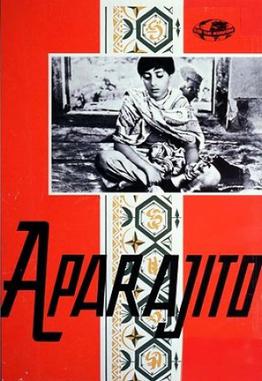
Platform: Amazon Prime / You Tube Free
Time: 1 hour 50 minutes
Director: Satyajit Ray
Cast: Kanu Banerjee (Harihar Roy). Karuna Banerjee (Sarbajaya Roy). Pinaki Sengupta (young Apurba “Apu” ). Smaran Ghosal (Apu – adolescent). Ramani Ranjan Sengupta (Apu’s great uncle).
Plot: Apu’s father Hairhar is still struggling to make ends meet with his wife Sarbajaya, in Varanasi where they had shifted. Young Apu is just wandering around, playing with neighboring kids. Hari dies and an uncle helps them to return to a village so that Apu can take up the family tradition of priesthood. Apu however in interested in studying and proves to be a bright student, winning second prize in the district due to which he gets a chance to study in Calcutta. Sarbajaya is fearful but the adolescent Apu wants to learn science and goes off to Calcutta where he works in a printing press at night while studying in a college during daytime, struggling to balancing sleep, studies, friendship and money…
This is the second Apu story, written by novelist Bibhutibhushan Bandopadhyay. This is also an unusual film from Ray in that it shows that Apu is not all that loyal to his parents, especially later to his struggling mother and even insensitive to her loneliness and pain – totally in contrast with how children were always shown loyal in various Indian language films. Apu emerges almost as ruthlessly selfish as befitting any teenager who thinks only about himself and doesn’t care what’s happening in his village home. Sarbajaya’s longing look at the distant railway tracks every time a train passes on the horizon, speaks volumes about her feelings than any long sets of dialogues can say or mean.
Apu is also discovering a world beyond his supposedly simple village life – the complexity of living in a city, earning his bread, paying his rent and studying. The professor who discovers Apu sleeping in the class and sends him out reminded me of one of my school principals who would rarely speak but just gesture with his fingers – as the onscreen professor does 😊.
Apu’s disinterest in priesthood and leanings towards science also makes a subtle point about how Apu looks at the world. His constant twirling of the small globe, which he carries around, shows a desire to go beyond his small world and look for adventures beyond his own world. He finds it in multiple ways and especially as a student, who is forced to balance his life between his village / mother, his studies, his job, and generally dealing with life. As mentioned earlier, Apu emerges as a somewhat selfish person, who thinks only about himself. Sarbajaya’s lonely death, shown in multiple cuts with her gradually fading away, cuts the last bond which Apu had with the village. Though he regrets not being there in her last moments, he tells his uncle that he will perform her last rites in Calcutta and leaves everything behind . He is now a full-fledged city man, awaiting new adventures beyond his limited world view.
Once again Subrata Mitra’s outstanding cinematography deserves a special mention. Be it the Varanasi ghats or lanes, or a steam train on the horizon as seen by Sarbajaya, almost everything leaps off the screen in utter crisp clarity.
To me, the film looks is a bit underwhelming. Maybe its the second film in a trilogy where everything is yet to develop and we do not know what Apu will grow into, since Apu is trying to find his place in the world – exactly like Ray, with his second film was trying to do so. Despite my misplaced feelings, the film cant be faulted in its story of a boy growing into a teenager and suddenly encountering the world and becoming a man.
The film is on Amazon Prime and FREE on You Tube . You tube link as below:
https://youtu.be/scgyxNLiAL8?t=35
Script – 5 out of 5
Story – 4 out of 5
Direction – 5 out of 5
Photography – 5 out of 5
Total – 4.8 out of 5
2 responses to “Aparajito (1956) – Classic / Apu Trilogy Part 2”
-
Hi Rammesh,
Just an aside on Subrata Mitra:
His entry at Wikipedia is worth reading, as it relates to the pioneering use of ‘bounce lighting’ in the Satyajit Ray films.
On the Hindi film side – Teesri Kasam.
IMHO, never has Waheeda Rehman looked as majestic as she does in this film, thanks to the lens of Subrata Misra.
An ace cinematographer such as him (and a select few in the Indian Film Industry) demonstrate to us that it is in accurate to call it a ‘black-and-white film’.
Their masterworks use two primary colors: pure black and pure white… and the infinite number of fractional color values between them, beyond what the human eye can decipher.
Thanks,
Robin
-
Robin
Thanks. Will check it out . As a rule I try NOT to check ANY reference site, (at the most imdb for the artist names) lest it interfere with what I have to say ;).
Now that you have mentioned it, I will check it out. Thanks again.
KVR
-


Leave a Reply