
Apur Sansar (1959) – Classic / Apu Trilogy part 3
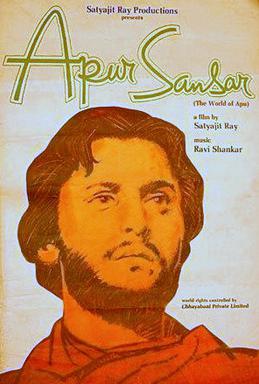
Genre: Human Drama
Platform: Free on You Tube with English subtitles
Time: 1 hour 50 minutes
Director: Satyajit Ray
Cast: Soumitra Chatterjee (Apurba “Apu” Kumar Roy). Sharmila Tagore (Aparna Roy, Apu’s wife). Swapan Mukherjee (Pulu, Apu’s friend). Dhiren Ghosh (Apu’s landlord). Dhiresh Majumdar (Sasinarayan, Aparna’s father). Alok Chakravarty (Kajal Roy, Apu and Aparna’s son).
Plot: Apu quits college in Inter and wishes to find a job. He and his friend Pulu go to Pulu’s village to attend his cousin Aparna’s wedding but Apu ends up getting to Aparna, since the groom turns out to be mentally unstable. Apu brings Aparna to Calcutta and she is appalled at his existence in a single room atop a tenement. Soon she adjusts and they find married bliss in their simple existence where she manages the home and he earns money by giving tuitions. Aparna goes back to her native village and dies at childbirth…
Spoiler Alert:
Let me start with the film’s last scene / ending; working backwards, (hopefully) the essence of this human story becomes clearer.
Apu’s estranged 5 year old son Kajal: Tumi Kaun (who are you)?
Apu: Aami tomar bandhu (I am your friend)
Life has come full circle for Apu. Hope. to Confidence. to Love. to Anger and Despair. And once again Hope.
From being an orphan, to a student, to a married man who loses his wife at childbirth and finally becoming a friend to his five-year-old son who is running wild, (since the child lacks any kind of authority figure to ‘control’ him), Apu has undergone the full life cycle, while still in his 20s.
At the film’s beginning, Apu sets out to get a job. His college professor wishes that he continues his studies but Apu is clear that lack of money prevents him from continuing his science education. On a journey to his friend Pulu’s native town Khulna, Pulu reads Apu’s novel and urges him to get it published but fate has other plans in the shape of Pulu’s young teenage cousin Aparna, played with incredible absolute confidence by a then 15-year-old Sharmila Tagore, who Apu is forced to marry out of a sense of saving the girl’s honor and future.
Losing her to the rigors of childbirth. Losing interest in life. Working in a remote mine and sending money to his father-in- law to take care of Kajal. Apu’s overall depression and anger is brought out well in these scenes. He is bitter that life has dealt a bad hand to him . So much that he even doesn’t want anything to do with his son.
Once again it is Pulu’s intervention that proves critical. Pulu brought him to the marriage and Aparna. It is Pulu again who traces the child Kajal and the father Apu, and brings them together. Pulu’s job is over. Will Kajal and Apu live as father and son? The answer is provided by Apu himself to Kajal ; aami tomar bandhu.
In my view this is an ideal conclusion to the story which is actually from the second half of the novel Aparajito. The full circle of life that started with Apu’s birth and his journey till date is known to us . Aparna’s death acts as one more among the many blows that life has dealt him. Yet he comes out of it and despite not knowing what the future holds, he moves on with his ‘bandhu’. As to what Apu and his “bandhu’ will do in the future and what life holds for them is left to our imagination.
Lyrical is the word that frequently comes to my mind while watching the film. The pace is even and the third film of the trilogy shows Ray , the master observer of human emotions, in complete command of the medium. Be it a small river in rural Bengal or a dank tenement near a railway yard, the images that leap out of the screen onto us show the realities of life as seen by Apu (and by us). Subrata Mitra’s cinematography again shows the contrast between the peaceful rural areas and Apu’s somewhat harried life in his one room rooftop tenement that is open to the elements. The film also began Ray’s long association with Soumitra Chatterjee who remained his preferred lead actor well into the 1980s, acting in 14 of Ray’s films, in varying roles.
As the end titles appear, we wish that there had been more about Kajal and his bandhu and we could have known more about them and what happened to them. This is easily the most perfect film of the trilogy and a classic by any definition.
The film is free on You Tube
Script – 5 out of 5
Story – 5 out of 5
Direction – 5 out of 5
Photography – 5 out of 5
Total – 5 out of 5
Leave a Reply
Want to join the discussion?Feel free to contribute!